(The basis for this essay is primarily Lecture #3 in Sharon Betcher's Constructive Theology II: Christology course at Vancouver School of Theology, augmented by my own prior knowledge.)
There has been a (somewhat unfortunate in its implications) trend in our culture in at least the last century or so, and possibly the last fifteen centuries, to wait for The One who will have the special gifts and ability to (rescue/liberate/redeem/transform) us and our reality. From DC Comics’ “Superman”, who comes to earth as the (one and only) last survivor of a superior alien race, to Neo from “The Matrix”, we entertain a fictional realm in which all of our trust can be placed in a solitary individual who is worthy of that trust.
The results in the real world can be seen in the political arena - candidates are elected based on whether or not they seem like The One we have expected. And if they do, then two possible tragedies can result, both of which can be observed in recent history. First, the candidate thinks of him- or herself as The One, chosen and gifted to shepherd the people into redemption, in which case democracy and social justice go off the rails. Or, the candidate turns out to be just another person after all, in which case the public is left disillusioned and resentful.
There is a third unfortunate result of this type of thinking - those of us who are convinced that we are not The One convince ourselves that we must wait. That we are not gifted and chosen, and therefore can not change the world. That we must simply bear the times until someone (alien? ontologically distinct? miraculous?) other than we arrives.
One possible route through this unfortunate development is offered by Spirit Christologies. The “spirit” image was one of the first to be used to make meaning around the life and death of Jesus of Nazareth. At the most basic level, they take Jesus to be a prophet of liberation and divine justice, bringing a spirit of resurrection to “dry bones” people, and ushering them into a new creation. Spirit pre-existed Jesus as a metaphor for the Divine, and some of his earliest followers came to speak of him being filled with the Spirit, thus becoming God’s adopted son.
The origin of this notion is related to the Exodus and Genesis stories, in which God’s spirit hovers over creation - first, in Exodus, the creation of a people from no-people, and second, in Genesis, the creation of a cosmos from a chaos. We also find the spirit hovering over the waters of baptism in the synoptic gospels - do we dare say that in Jesus’ baptism God is creating a son from a man who was no man’s son?
Jesus, then, was a man around whom the spirit of God was particularly active. People who had been “dry bones” felt resurrected in his presence, as though by the breath of God. People who felt (or were) ostracized or homeless suddenly found themselves “adopted” into a new household - created into a new people. People who were abused, humiliated, raped, and degraded found themselves turned into some-bodies, instead of no-bodies. And after his death, this spirit was still accessible to them.
The greatest problem with these Spirit Christologies is that they conflict with classical theism and trinitarian theologies. According to the trinitarian view (which was normative in Christianity from the councils of the 4th and 5th centuries CE right up until the second half of the 20th) the Spirit is very clearly the “third” of the three members. It came after Jesus (on the day of Pentecost) and was his representative on Earth. If it was active before he came, and if it was the agency by which he worked, then the trinitarian view becomes highly unstable.
Likewise classical theism, which holds that Jesus is “begotten, not made”. The Universe was made by God, and then fell away into sin, says classical theism. Therefore anything that arises from the “made” universe is tainted. Jesus, in order to be divine, needs to come from “outside” the made-ness of creation (not unlike Superman being flung to our planet from another galaxy). Only a Jesus who was “eternally begotten of the father” could do what classical theism required him to have done - redeem a world that was ontologically fallen. Adoption by the spirit was simply not enough to satisfy the demands of the 4th century church.
If we are no longer beholden to classical theism (defined by Sharon Betcher in her lecture as “depending on a big God-Daddy outside the world”) and do not consider the world to be “fallen” from perfection into an ontological state of evil (but rather, perhaps, “fallen” into illusion and disharmony) then we do not require a Christ who was begotten outside of creation. Can we perhaps find meaning for our lives in spirit christology, as so many have in the last several decades?
One benefit that these approaches offer is in response to the problem outlined above, regarding waiting for The One. If the purpose of The One is to empower us with the Spirit, then we need not wait, because that spirit is moving now. All we must do is step out to meet it. And if we wait to put all of our trust into one individual, without trusting ourselves to be vessels of the spirit, then we will inevitably be disappointed. This will be seen as threatening, though, to many who hold religious authority and who wish to be the arbiters of theological truth.
To this point, my definition of a Christian has been “any person for whom Jesus holds decisive theological significance.” One criterion of a defensible Christology, then, is the role of Jesus in these terms. I believe that Spirit Christologies have no problems in this area. For when people encountered Jesus, they found themselves filled with the spirit, renewed, liberated, resurrected. And people continue to have this experience when they encounter the stories of him, and the community (of some-bodies) that continues to bear his name.
Someday, perhaps, that experience will no longer be accessible through him and his stories, but the spirit will nevertheless continue to blow new life into dry bones.
Tuesday, January 26, 2010


Thursday, January 21, 2010
The Christ That Emerges From Within
(This update is based on a few sources: Marianne Sawicki’s “Seeing The Lord: Resurrection and Early Christian Practices”, Lecture #2 of Sharon Betcher’s “Constructive Theology II: Christology” course at Vancouver School of Theology, and my own reflections and accumulated insights. The one reference to Jay McDaniel is from his book “Living From the Center”.)
In her book “Seeing The Lord”, Marianne Sawicki outlines a key conceptual difference between the Hellenic and Northern European languages (including Greek and English) and the Semitic languages (including Hebrew and Aramaic). While the northern languages, originating in locales where hardship is represented by cold, wet, dirty, and dark (evocative of winter), favour light, cleanliness, and spaciousness as hallmarks of goodness, the Semitic languages, originating in desert regions where heat, light, and exposure to the air are threats to wellbeing, place value in the cool, wet, dimness of twilight and the earthy, “fleshy” solidity of gardens, riverbanks, and orchards. One of the responsibilities of Christian interpreters in post-modernity is to identify locations in our tradition where this (essentially irreconcilable) interface has resulted in confusion, distortion, or abuse.
“Cosmic Christologies” describe a theology of the nature of Christ relative to the doctrine of creation, as a counterpoint to a reductionist, mechanical, essentialist understanding. This understanding consigns the Christ-event to a moment in history and reduces the definition of Christ to the figure of Jesus. Alternately, a cosmic Christology, while acknowledging a decisive significance for the life and times of Jesus, allows the universe itself to serve as the vessel for the Christ-principle. The Christ is the “wisdom” or “spirit” present in the cosmos, which became visible and enfleshed in Jesus of Nazareth.
The above conceptual interface between the Hellenic and the Semitic comes into play heavily when it comes to the relationship between the Christ and the Cosmos. It is not difficult to imagine, given the Hellenic value of spaciousness, cleanliness, and light, that it is the Greek influence which gives us the notion of a Christ that exists outside or beyond the world - free of the “muck” and shadow and ambiguity of enfleshed life. This Christ must, by its own divine agency, inject itself into history in order to redeem humankind from its shadowed, impure, unclean sinfulness. The Christ travels from the pure “light” of the divine into the “fallen” cosmos, pulling humanity out of the earth in a once-and-for-all ontological gesture of atonement.
Cosmic Christology, however, tends to favour the Semitic view - that the cosmos is heavy or “saturated” with the divine. The divine settles upon us like dew upon the mulch at twilight, and rests in the corners of reality the way blessed shadows cover the corners of a room. The incarnation of the Christ in Jesus is thus not a once-and-for-all injection of divinity into the world, but a “recapitulation” or reminder of the way in which the divine has operated in the cosmos from the very beginning. The Christ-principle (differently described as Sophia/Wisdom or Logos/Word) is revealed in Jesus not as a coming-from-without, but as a surfacing-from-within.
I have used the Hellenic/Semitic dialectic in order to highlight an important element of Cosmic Christology: it is neither new, nor is it a fringe-view. But because the dualistic/reductionist/mechanical/essentialist worldview has held sway in the post-Enlightenment West, it may seem that contrary ideas are novel or revolutionary. Especially so in this case, as this Christology bears much similarity to Mahayana Buddhism, which holds that the Buddha-individual is an earthly projection of the eternal Dharmakaya principle, and thus may be perceived as a post-modern syncretism or “new age” novelty.
As revolutionary as this view may seem to many on-the-ground in our Christian communities, it is nonetheless extremely ancient in the Church and has much to offer us in post-modernity. One gift that it offers is the very compatibility with certain other world religions that I mentioned above. The good here is not in any attempt to manufacture a “super-religion” or to blur the boundaries between the faith traditions, but is in finding components of the traditions that can be laid side-by-side and appreciated across those boundaries.
The primary gift of this view for post-modernity depends on the difficulty that post-moderns have with the notion of a fallen world that needed to be redeemed through an act of atonement by the ontologically-unique figure of Jesus. This is a sticking point for many in our congregations (especially in the United Church of Canada) and the ability to offer an alternative view that is rooted in cultural dialectics that were already current in the first century CE is a great boon. The flipside to this benefit is the relative peripheralization of the cross and of Jesus himself. Do Jesus and the cross remain constitutive of the church in this theology?
Certainly the cross, according to this view, is moved out of the center of things, to be replaced by the reconciling love of God. And in a sense, this theology would be entirely available to humankind without the life and story of Jesus. However, both remain constitutive because the life and story of Jesus show us how the love of God operates in the world, and the cross reminds us that love continues to be crucified (after Jay McDaniel).
And, finally, given the present dramatic increase in ecological awareness and concern, we could do worse than to embrace a Cosmic Christology, which sees the Christ-principle as pervading and enlivening the entire world. For according to this view, when we take advantage of the world which was generated by God’s creative love, we engage in nothing less than the crucifixion of the Christ.
In her book “Seeing The Lord”, Marianne Sawicki outlines a key conceptual difference between the Hellenic and Northern European languages (including Greek and English) and the Semitic languages (including Hebrew and Aramaic). While the northern languages, originating in locales where hardship is represented by cold, wet, dirty, and dark (evocative of winter), favour light, cleanliness, and spaciousness as hallmarks of goodness, the Semitic languages, originating in desert regions where heat, light, and exposure to the air are threats to wellbeing, place value in the cool, wet, dimness of twilight and the earthy, “fleshy” solidity of gardens, riverbanks, and orchards. One of the responsibilities of Christian interpreters in post-modernity is to identify locations in our tradition where this (essentially irreconcilable) interface has resulted in confusion, distortion, or abuse.
“Cosmic Christologies” describe a theology of the nature of Christ relative to the doctrine of creation, as a counterpoint to a reductionist, mechanical, essentialist understanding. This understanding consigns the Christ-event to a moment in history and reduces the definition of Christ to the figure of Jesus. Alternately, a cosmic Christology, while acknowledging a decisive significance for the life and times of Jesus, allows the universe itself to serve as the vessel for the Christ-principle. The Christ is the “wisdom” or “spirit” present in the cosmos, which became visible and enfleshed in Jesus of Nazareth.
The above conceptual interface between the Hellenic and the Semitic comes into play heavily when it comes to the relationship between the Christ and the Cosmos. It is not difficult to imagine, given the Hellenic value of spaciousness, cleanliness, and light, that it is the Greek influence which gives us the notion of a Christ that exists outside or beyond the world - free of the “muck” and shadow and ambiguity of enfleshed life. This Christ must, by its own divine agency, inject itself into history in order to redeem humankind from its shadowed, impure, unclean sinfulness. The Christ travels from the pure “light” of the divine into the “fallen” cosmos, pulling humanity out of the earth in a once-and-for-all ontological gesture of atonement.
Cosmic Christology, however, tends to favour the Semitic view - that the cosmos is heavy or “saturated” with the divine. The divine settles upon us like dew upon the mulch at twilight, and rests in the corners of reality the way blessed shadows cover the corners of a room. The incarnation of the Christ in Jesus is thus not a once-and-for-all injection of divinity into the world, but a “recapitulation” or reminder of the way in which the divine has operated in the cosmos from the very beginning. The Christ-principle (differently described as Sophia/Wisdom or Logos/Word) is revealed in Jesus not as a coming-from-without, but as a surfacing-from-within.
I have used the Hellenic/Semitic dialectic in order to highlight an important element of Cosmic Christology: it is neither new, nor is it a fringe-view. But because the dualistic/reductionist/mechanical/essentialist worldview has held sway in the post-Enlightenment West, it may seem that contrary ideas are novel or revolutionary. Especially so in this case, as this Christology bears much similarity to Mahayana Buddhism, which holds that the Buddha-individual is an earthly projection of the eternal Dharmakaya principle, and thus may be perceived as a post-modern syncretism or “new age” novelty.
As revolutionary as this view may seem to many on-the-ground in our Christian communities, it is nonetheless extremely ancient in the Church and has much to offer us in post-modernity. One gift that it offers is the very compatibility with certain other world religions that I mentioned above. The good here is not in any attempt to manufacture a “super-religion” or to blur the boundaries between the faith traditions, but is in finding components of the traditions that can be laid side-by-side and appreciated across those boundaries.
The primary gift of this view for post-modernity depends on the difficulty that post-moderns have with the notion of a fallen world that needed to be redeemed through an act of atonement by the ontologically-unique figure of Jesus. This is a sticking point for many in our congregations (especially in the United Church of Canada) and the ability to offer an alternative view that is rooted in cultural dialectics that were already current in the first century CE is a great boon. The flipside to this benefit is the relative peripheralization of the cross and of Jesus himself. Do Jesus and the cross remain constitutive of the church in this theology?
Certainly the cross, according to this view, is moved out of the center of things, to be replaced by the reconciling love of God. And in a sense, this theology would be entirely available to humankind without the life and story of Jesus. However, both remain constitutive because the life and story of Jesus show us how the love of God operates in the world, and the cross reminds us that love continues to be crucified (after Jay McDaniel).
And, finally, given the present dramatic increase in ecological awareness and concern, we could do worse than to embrace a Cosmic Christology, which sees the Christ-principle as pervading and enlivening the entire world. For according to this view, when we take advantage of the world which was generated by God’s creative love, we engage in nothing less than the crucifixion of the Christ.
Thursday, January 14, 2010
Epiphany and the Rhythms of Christology
(This entry is based on three major sources: Chapter 1 of Marianne Sawicki’s “Seeing The Lord: Resurrection and Early Christian Practices”, Lecture #1 of Sharon Betcher’s “Constructive Theology II: Christology” course at Vancouver School of Theology, and a recent sermon that I preached on the Epiphany and the story of the Magi (Matthew 2:1-12).)
In the wake of Epiphany, I have been reflecting on the story of the magi in Matthew 2. So much has been made of this story throughout the history of the church, that isn’t present in the text itself. Much of the elaborations to the story are rooted in medieval and modernist understandings of christology, ecclesiology, and missiology.
Sharon Betcher, in her course “Constructive Theology II: Christology” at Vancouver School of Theology, insists that it is the responsibility of contemporary theologians to “decolonize” christology for the post-modern condition. For lay people, this will mostly consist of removing the lenses of various “-isms” to see the Christ and the christ-story as being multi-valent, mysterious, and life-giving in the here and now. Some of these -isms include:
• ethnocentrism - the belief that one’s culture is superior
• sexism - the belief that one’s gender is superior - this one comes in both feminist and patriarchal forms
• anthropocentrism - the belief that humankind is of supreme value relative to the natural world
• essentialism - the belief that there is one truth to any reality or one answer to any question
• supersessionism - the belief that one’s religious tradition is superior to all others, and renders them obsolete
All of these “-isms” have combined in the church to create a monolithic institution that I and others have come to call “Christendom”. A major piece of the work of public theology in the coming decades will be to liberate the notion of “Christianity” from the burdens of “Christendom” in the imaginations of the people.
What, then, is left when the lenses of these -isms (and Christendom) are removed? Let us use the story of the magi as an example. The tale in Matthew 2 is quite straightforward: astrologers (or “magi”) from afar observe an omen in the heavens, of the birth of a new “King of the Jews”. They travel to Jerusalem and ask devious, brutal King Herod about the birth. He, sensing a threat to his power, finds out where the messiah is foretold to be born, and sends the magi to Bethlehem, telling them to find the child and report back to him, so that he might also go and pay homage. The magi find the house by walking toward the star that first alerted them to the birth. When they see the modest house in the small village, they “rejoice with much great joy”. Then they pay homage to the child and give him three gifts. They do not return to King Herod or Jerusalem, but go straight home.
Chances are a majority of North American readers know something of this story, from nativity scenes, holiday carols, or greeting cards. But the story commonly known in the culture is known through the lenses from which we are asked to “de-colonize” it. Perhaps you are surprised to hear that there are no shepherds or angels in the story. But these elements come from the gospel of Luke, and do not appear in the gospel of Matthew. Including them in the same story is an example of “essentialism”. If there is only one truth, then both stories must be held as one in an act that biblical scholars call “conflation”. When we conflate the stories, we ignore their distinctiveness and lose our grasp on what they are trying to communicate to us.
When, on the other hand, we hold the stories not as one-and-the-same but as separate-and-parallel, we can pick out the relative emphases of their authors and gain access to what they want us to understand. While Luke wishes to make a distinction between rich and poor (shepherds being the “working poor”), Matthew rather chooses to distinguish the ambition of power (Herod) from the love of wisdom (the Magi). When we conflate them, we place all of the emphasis on the baby Jesus (“to whom every knee shall bow”) and lose the mysterious, dynamic energy that can come from holding them parallel, but separate. This is the gift of the post-modern approach to scripture.
You might also have been surprised to read that these figures are not “Kings” but “magi”. Last week I attended a worship service in which we sang the Epiphany hymn “We Three Kings of Orient Are”. This song is based upon a medieval tradition which held that the visitors to the infant Jesus were the Kings of India, Arabia, and Persia. In this tradition we encounter the strength of Christian supersessionism, which holds that all the traditions of the world find their fulfillment in the figure of Jesus. Treating the story in this way justifies the colonization of the East by the West. According to this view, we need not feel uncomfortable with such colonialism, since at the very beginning of Jesus’ life, the Kings of those regions bowed before him and recognized his right to rule. When we de-colonize this story by removing this unfortunate (non-biblical) layer of tradition, we can begin to redress some of the wrongs done during the colonial era.
Nor are they “Wise Men”. True, the Greek word “magoi” is in the masculine plural, but this does not preclude the inclusion of women among their number, nor in fact that the group may have been entirely made up of women. A post-modern reading encourages us to let go of an anxious attachment to phony historicity and allow the power of the narrative to convey us to meaning. How does the story impact us if we imagine a group of women? Or a mix of men and women? A rigid conviction that they must have been men reflects a patriarchal cultural paradigm.
Finally, you may be interested to note that they do not follow the star from the East to the West. They see the star in the eastern sky, and it prompts them on a westward journey. It is only after they have encountered Herod, and begin to backtrack toward Bethlehem (which lies to the east of Jerusalem) that the star beckons them on. However, it supports western ethnocentrism to believe that God sends the eastern peoples on divine pilgrimages to pay tribute to western religion. It is a jarring experience for many people who believe they are familiar with this story, to imagine the magi travelling all the way to Judea with the star of their divinations not in front of them, but at their backs. Matthew’s intent in telling the story this way becomes clear, when the magi realize (and we with them) that the placement of the star is meant to help them find their way NOT from the “orient” to the west, but from Jerusalem, the seat of power and greed, to the little town of Bethlehem.
In Chapter 1 of her book “Seeing The Lord: Resurrection and Early Christian Practices”, Marianne Sawicki defines the church as those people who are able to identify the risen lord as being Jesus of Nazareth, and how to acknowledge the spirit of Jesus as a tangible agency in their midst. They “know” these abilities in part cerebrally and in part somatically. Theology therefore becomes a matter of mind-body exploration, of which propositional argument is only a small part (others including poetic discourse, liturgical drama, and social activity). Over the ages, the church has done its best to “see” the Lord in the light of its historical context and to treat the stories of the tradition with gentle hands (Sawicki uses the image of the “Pieta” - Jesus falling from the cross into the arms of Mother Mary - as a symbol for how he also fell into the arms of “Mother Church”).
So, if we are to shed the superstructure of medieval and modernist Christianity in order to construct a theology that is somatically, psychologically, and cerebrally meaningful and powerful in the context of post-modernity, what will we need to do?
Once again, we can turn to the magi of Matthew 2 for guidance. The magi, in their wisdom-love (as distinct from Herod’s power-ambition), discern an omen of good news. All that they know is that it is a birth, and the nation in which it took place. They have no other guidance of their own - not even the star that gave them the news will show them the way. So they must feel their way forward, trusting that good things lie in store. Theirs is a journey of personal transformation, as they encounter Herod and the infant Christ - encounters which will mark them forever.
Can there be a Christianity (or a Christology) independent of Christian supersessionism, ethnocentrism, and essentialism? I believe I have provided an example of what this post-Christendom Christianity can look like, in my analysis of Matthew 2:1-12. When liberated from Christendom, the story continues to have spiritual power - and this power is relevant and meaningful in post-modernity. When focus is shifted off of the baby Jesus and the cosmic meaning of his birth, we are able to see ourselves in roles other than passive observers who give rational assent to doctrine. We become somatic participants in the drama of the gospel, journeying with the magi, encountering Herod, seeing the Lord, and returning by another path. And this, the epiphany traditions assure us, is the rhythm of “doing” Christology.
In the wake of Epiphany, I have been reflecting on the story of the magi in Matthew 2. So much has been made of this story throughout the history of the church, that isn’t present in the text itself. Much of the elaborations to the story are rooted in medieval and modernist understandings of christology, ecclesiology, and missiology.
Sharon Betcher, in her course “Constructive Theology II: Christology” at Vancouver School of Theology, insists that it is the responsibility of contemporary theologians to “decolonize” christology for the post-modern condition. For lay people, this will mostly consist of removing the lenses of various “-isms” to see the Christ and the christ-story as being multi-valent, mysterious, and life-giving in the here and now. Some of these -isms include:
• ethnocentrism - the belief that one’s culture is superior
• sexism - the belief that one’s gender is superior - this one comes in both feminist and patriarchal forms
• anthropocentrism - the belief that humankind is of supreme value relative to the natural world
• essentialism - the belief that there is one truth to any reality or one answer to any question
• supersessionism - the belief that one’s religious tradition is superior to all others, and renders them obsolete
All of these “-isms” have combined in the church to create a monolithic institution that I and others have come to call “Christendom”. A major piece of the work of public theology in the coming decades will be to liberate the notion of “Christianity” from the burdens of “Christendom” in the imaginations of the people.
What, then, is left when the lenses of these -isms (and Christendom) are removed? Let us use the story of the magi as an example. The tale in Matthew 2 is quite straightforward: astrologers (or “magi”) from afar observe an omen in the heavens, of the birth of a new “King of the Jews”. They travel to Jerusalem and ask devious, brutal King Herod about the birth. He, sensing a threat to his power, finds out where the messiah is foretold to be born, and sends the magi to Bethlehem, telling them to find the child and report back to him, so that he might also go and pay homage. The magi find the house by walking toward the star that first alerted them to the birth. When they see the modest house in the small village, they “rejoice with much great joy”. Then they pay homage to the child and give him three gifts. They do not return to King Herod or Jerusalem, but go straight home.
Chances are a majority of North American readers know something of this story, from nativity scenes, holiday carols, or greeting cards. But the story commonly known in the culture is known through the lenses from which we are asked to “de-colonize” it. Perhaps you are surprised to hear that there are no shepherds or angels in the story. But these elements come from the gospel of Luke, and do not appear in the gospel of Matthew. Including them in the same story is an example of “essentialism”. If there is only one truth, then both stories must be held as one in an act that biblical scholars call “conflation”. When we conflate the stories, we ignore their distinctiveness and lose our grasp on what they are trying to communicate to us.
When, on the other hand, we hold the stories not as one-and-the-same but as separate-and-parallel, we can pick out the relative emphases of their authors and gain access to what they want us to understand. While Luke wishes to make a distinction between rich and poor (shepherds being the “working poor”), Matthew rather chooses to distinguish the ambition of power (Herod) from the love of wisdom (the Magi). When we conflate them, we place all of the emphasis on the baby Jesus (“to whom every knee shall bow”) and lose the mysterious, dynamic energy that can come from holding them parallel, but separate. This is the gift of the post-modern approach to scripture.
You might also have been surprised to read that these figures are not “Kings” but “magi”. Last week I attended a worship service in which we sang the Epiphany hymn “We Three Kings of Orient Are”. This song is based upon a medieval tradition which held that the visitors to the infant Jesus were the Kings of India, Arabia, and Persia. In this tradition we encounter the strength of Christian supersessionism, which holds that all the traditions of the world find their fulfillment in the figure of Jesus. Treating the story in this way justifies the colonization of the East by the West. According to this view, we need not feel uncomfortable with such colonialism, since at the very beginning of Jesus’ life, the Kings of those regions bowed before him and recognized his right to rule. When we de-colonize this story by removing this unfortunate (non-biblical) layer of tradition, we can begin to redress some of the wrongs done during the colonial era.
Nor are they “Wise Men”. True, the Greek word “magoi” is in the masculine plural, but this does not preclude the inclusion of women among their number, nor in fact that the group may have been entirely made up of women. A post-modern reading encourages us to let go of an anxious attachment to phony historicity and allow the power of the narrative to convey us to meaning. How does the story impact us if we imagine a group of women? Or a mix of men and women? A rigid conviction that they must have been men reflects a patriarchal cultural paradigm.
Finally, you may be interested to note that they do not follow the star from the East to the West. They see the star in the eastern sky, and it prompts them on a westward journey. It is only after they have encountered Herod, and begin to backtrack toward Bethlehem (which lies to the east of Jerusalem) that the star beckons them on. However, it supports western ethnocentrism to believe that God sends the eastern peoples on divine pilgrimages to pay tribute to western religion. It is a jarring experience for many people who believe they are familiar with this story, to imagine the magi travelling all the way to Judea with the star of their divinations not in front of them, but at their backs. Matthew’s intent in telling the story this way becomes clear, when the magi realize (and we with them) that the placement of the star is meant to help them find their way NOT from the “orient” to the west, but from Jerusalem, the seat of power and greed, to the little town of Bethlehem.
In Chapter 1 of her book “Seeing The Lord: Resurrection and Early Christian Practices”, Marianne Sawicki defines the church as those people who are able to identify the risen lord as being Jesus of Nazareth, and how to acknowledge the spirit of Jesus as a tangible agency in their midst. They “know” these abilities in part cerebrally and in part somatically. Theology therefore becomes a matter of mind-body exploration, of which propositional argument is only a small part (others including poetic discourse, liturgical drama, and social activity). Over the ages, the church has done its best to “see” the Lord in the light of its historical context and to treat the stories of the tradition with gentle hands (Sawicki uses the image of the “Pieta” - Jesus falling from the cross into the arms of Mother Mary - as a symbol for how he also fell into the arms of “Mother Church”).
So, if we are to shed the superstructure of medieval and modernist Christianity in order to construct a theology that is somatically, psychologically, and cerebrally meaningful and powerful in the context of post-modernity, what will we need to do?
Once again, we can turn to the magi of Matthew 2 for guidance. The magi, in their wisdom-love (as distinct from Herod’s power-ambition), discern an omen of good news. All that they know is that it is a birth, and the nation in which it took place. They have no other guidance of their own - not even the star that gave them the news will show them the way. So they must feel their way forward, trusting that good things lie in store. Theirs is a journey of personal transformation, as they encounter Herod and the infant Christ - encounters which will mark them forever.
Can there be a Christianity (or a Christology) independent of Christian supersessionism, ethnocentrism, and essentialism? I believe I have provided an example of what this post-Christendom Christianity can look like, in my analysis of Matthew 2:1-12. When liberated from Christendom, the story continues to have spiritual power - and this power is relevant and meaningful in post-modernity. When focus is shifted off of the baby Jesus and the cosmic meaning of his birth, we are able to see ourselves in roles other than passive observers who give rational assent to doctrine. We become somatic participants in the drama of the gospel, journeying with the magi, encountering Herod, seeing the Lord, and returning by another path. And this, the epiphany traditions assure us, is the rhythm of “doing” Christology.
Thursday, September 13, 2007
Sermon From July 1st, 2007
This is the first of my two favourite "manuscript" sermons of the summer. They were both delivered at Gilmore Park United Church in July. I'll post the other one in a few days, possibly followed by one or more from August.
Sermon
July 1, 2007
Murray Speer
Luke 9:51-62
And when the time came for his taking-up, he hardened his face, deciding firmly to travel into Jerusalem.
We sometimes forget what it meant for Jesus to decide to travel into Jerusalem.
We sometimes forget, and sometimes it is impossible for us to understand. Some of us will understand better than others, no doubt.
Jerusalem was the great city of the Jews, of course we know that. It was the city of the temple – one of the seven wonders of the ancient world. It was the city where the festivals happened, and with the exception of Alexandria in Egypt, it was the city where the greatest teachers of Judaism lived.
It was also a Roman city. And in Roman-occupied Judea, Jerusalem was a hotbed of activity. Protests and police actions, minor uprisings and reprisals, abuses by soldiers and inflammatory speeches on street corners and in marketplaces.
Something we can easily forget, partly because of how the church has read passages like this through history, is that Jerusalem is not only a dangerous place in today’s world. It has been a dangerous place at many different times and for many different kinds of people.
So when Jesus “sets his face,” which is an idiom meaning to make a firm decision – no going back – he is facing a city of controversy and violence, oppression and activism, terrorism and angry rhetoric.
We sometimes forget what it meant for Jesus to go to Jerusalem. This was never a vacation. It was never a whim. It was a hard decision to make, and when he made it, he made it firmly. He set his face.
I can imagine some of the things he heard from his followers. The story doesn’t tell us, but we can fill in some of the gaps. “Master, why should we leave Galilee? We’re doing pretty well here. People are listening to you, and it’s comfortable. Why should we go where the soldiers and fanatics and zealots are? Why should we go to a Roman city where they arrest and crucify? Let’s stay here at home, we can do so much good here.”
Depending how you think about Jesus, your response may vary. A lot of preachers I consulted this week prescribe to the idea that Jesus was not here to stay, but “here to go.” His mission was to get killed, and Jerusalem was where he needed to be, so he went. Simple as that.
I don’t think Jesus was here to go. I don’t think it was quite so easy. I suspect those days of prayer and reflection before he “set his face” were probably filled with fear and doubt. Can I really preach a message of peace and God’s justice – God’s shalom – in a city so full of anger and violence? Is this really the best way to use my gifts?
The parallels in my own life simply don’t exist. I considered talking to you today about my journey in ministry… as a candidate, trusting the call of God… as an intern, making a physical journey across the country as well as a spiritual journey of preparation and learning… but the parallels simply don’t exist. I suspect few of us here today can really imagine what this “firm decision to travel to Jerusalem” really meant to Jesus and his followers at the time.
So you can see why some of his, shall we say, less committed followers started looking for excuses. When we forget how serious this firm decision is, to travel to Jerusalem, these three stories that follow might not make a lot of sense to us.
Luke takes these sayings of Jesus, that were around in written form before he incorporated them into his gospel, and puts them into a specific context for us. The context is, Jesus is no longer wandering around teaching in Galilee. Jesus has set his face for Jerusalem. He has stopped being a wandering teacher, and he has become a prophet. On his way to the Holy City. Where violence and fanaticism await him.
And then we get these three little sayings.
A fervent follower tells Jesus that he will follow him anywhere. Jesus reminds him that they are not heading toward material prosperity or social comfort of any kind. The Son of Man has nowhere to lay his head. Do not be under any illusion about our mission.
Another follower, on hearing what’s next on the agenda, says, “Um, well, actually, you see, I’ve just had a death in the family and, um… well, the commandment says to honour your mother and father and, uhh…” Jesus says, when it’s time to go, it’s time to go. Leave the dead to bury the dead.
A third person comes to Jesus and says, “You know what? You go ahead and I’ll catch up.” I wonder if he had any intention of leaving his household to travel to Jerusalem. Jesus tells him that this sort of vascillation is unsuitable for someone who seeks the kingdom. Anyone who puts his hand to the plow and then looks backward is unfit.
Do you see what Luke has done? These harsh words of Jesus do not stand alone, outside of context, in Luke’s gospel. Rather, they take place at a harsh time, when harsh choices are being made. One follower is a bit too eager to get to Jerusalem, and Jesus must remind him. Two others are reluctant to follow Jesus’ firm decision, and Jesus must tell them that they are either in or out…
The parallels to my life don’t exist. I simply haven’t faced this kind of harsh reality. There are a lot of preachers out there who try to tell their people that this kind of choice IS necessary right here and now… you are either in or out!!! They call. Make your choice or be left behind!!! They shout.
But that’s just not the way it is for us. We have it pretty good. Nobody is seriously threatening our way of life. The places where Christians are routinely harassed or killed for doing Christian things are half a world away – though much closer than that emotionally for many of us. This harsh reality, this kind of difficult choice, is beyond the experience of many of us here.
We simply haven’t been in a position to make the kind of tough decision that Jesus makes. Most of us. But some of us have. Those Christian workers I mentioned earlier, half a world away? 600 of them were killed in the Phillipines between 2001 and 2006. They are making this kind of decision.
Christians who opposed apartheid in South Africa, and who fought for civil rights in the United States, made this kind of decision.
People who struggle with very real illnesses, mental disorders, and addictions try very hard to make decisions like these.
And we can’t know when we might be asked to “set our face” in the direction of God.
And here’s the good news: If and when that time comes, we will know that we are not alone. We will know that Jesus has been there before, as have thousands of our Christian siblings across the world and throughout history.
Jesus, in setting his face for Jerusalem, was utterly committed to the gospel and to God’s divine shalom – peace through justice. And he was utterly uncommitted to anything else. And it’s because of that commitment, that passion, that hardening of his face and his refusal to stay where things are safe and easy, that his name continues to be spoken today.
Thanks be to God.
Sermon
July 1, 2007
Murray Speer
Luke 9:51-62
When the days drew near for him to be taken up, he set his face to go to Jerusalem. And he sent messengers ahead of him. On their way they entered a village of the Samaritans to make ready for him; but they did not receive him, because his face was set toward Jerusalem. When his disciples James and John saw it, they said, “Lord, do you want us to command fire to come down from heaven and consume them?” But he turned and rebuked them. Then they went on to another village.
As they were going along the road, someone said to him, “I will follow you wherever you go.” And Jesus said to him, “Foxes have holes, and birds of the air have nests; but the Son of Man has nowhere to lay his head.” To another he said, “Follow me.” But he said, “Lord, first let me go and bury my father.” But Jesus said to him, “Let the dead bury their own dead; but as for you, go and proclaim the kingdom of God.” Another said, “I will follow you, Lord; but let me first say farewell to those at my home.” Jesus said to him, “No one who puts a hand to the plow and looks back is fit for the kingdom of God.”
And when the time came for his taking-up, he hardened his face, deciding firmly to travel into Jerusalem.
We sometimes forget what it meant for Jesus to decide to travel into Jerusalem.
We sometimes forget, and sometimes it is impossible for us to understand. Some of us will understand better than others, no doubt.
Jerusalem was the great city of the Jews, of course we know that. It was the city of the temple – one of the seven wonders of the ancient world. It was the city where the festivals happened, and with the exception of Alexandria in Egypt, it was the city where the greatest teachers of Judaism lived.
It was also a Roman city. And in Roman-occupied Judea, Jerusalem was a hotbed of activity. Protests and police actions, minor uprisings and reprisals, abuses by soldiers and inflammatory speeches on street corners and in marketplaces.
Something we can easily forget, partly because of how the church has read passages like this through history, is that Jerusalem is not only a dangerous place in today’s world. It has been a dangerous place at many different times and for many different kinds of people.
So when Jesus “sets his face,” which is an idiom meaning to make a firm decision – no going back – he is facing a city of controversy and violence, oppression and activism, terrorism and angry rhetoric.
We sometimes forget what it meant for Jesus to go to Jerusalem. This was never a vacation. It was never a whim. It was a hard decision to make, and when he made it, he made it firmly. He set his face.
I can imagine some of the things he heard from his followers. The story doesn’t tell us, but we can fill in some of the gaps. “Master, why should we leave Galilee? We’re doing pretty well here. People are listening to you, and it’s comfortable. Why should we go where the soldiers and fanatics and zealots are? Why should we go to a Roman city where they arrest and crucify? Let’s stay here at home, we can do so much good here.”
Depending how you think about Jesus, your response may vary. A lot of preachers I consulted this week prescribe to the idea that Jesus was not here to stay, but “here to go.” His mission was to get killed, and Jerusalem was where he needed to be, so he went. Simple as that.
I don’t think Jesus was here to go. I don’t think it was quite so easy. I suspect those days of prayer and reflection before he “set his face” were probably filled with fear and doubt. Can I really preach a message of peace and God’s justice – God’s shalom – in a city so full of anger and violence? Is this really the best way to use my gifts?
The parallels in my own life simply don’t exist. I considered talking to you today about my journey in ministry… as a candidate, trusting the call of God… as an intern, making a physical journey across the country as well as a spiritual journey of preparation and learning… but the parallels simply don’t exist. I suspect few of us here today can really imagine what this “firm decision to travel to Jerusalem” really meant to Jesus and his followers at the time.
So you can see why some of his, shall we say, less committed followers started looking for excuses. When we forget how serious this firm decision is, to travel to Jerusalem, these three stories that follow might not make a lot of sense to us.
Luke takes these sayings of Jesus, that were around in written form before he incorporated them into his gospel, and puts them into a specific context for us. The context is, Jesus is no longer wandering around teaching in Galilee. Jesus has set his face for Jerusalem. He has stopped being a wandering teacher, and he has become a prophet. On his way to the Holy City. Where violence and fanaticism await him.
And then we get these three little sayings.
A fervent follower tells Jesus that he will follow him anywhere. Jesus reminds him that they are not heading toward material prosperity or social comfort of any kind. The Son of Man has nowhere to lay his head. Do not be under any illusion about our mission.
Another follower, on hearing what’s next on the agenda, says, “Um, well, actually, you see, I’ve just had a death in the family and, um… well, the commandment says to honour your mother and father and, uhh…” Jesus says, when it’s time to go, it’s time to go. Leave the dead to bury the dead.
A third person comes to Jesus and says, “You know what? You go ahead and I’ll catch up.” I wonder if he had any intention of leaving his household to travel to Jerusalem. Jesus tells him that this sort of vascillation is unsuitable for someone who seeks the kingdom. Anyone who puts his hand to the plow and then looks backward is unfit.
Do you see what Luke has done? These harsh words of Jesus do not stand alone, outside of context, in Luke’s gospel. Rather, they take place at a harsh time, when harsh choices are being made. One follower is a bit too eager to get to Jerusalem, and Jesus must remind him. Two others are reluctant to follow Jesus’ firm decision, and Jesus must tell them that they are either in or out…
The parallels to my life don’t exist. I simply haven’t faced this kind of harsh reality. There are a lot of preachers out there who try to tell their people that this kind of choice IS necessary right here and now… you are either in or out!!! They call. Make your choice or be left behind!!! They shout.
But that’s just not the way it is for us. We have it pretty good. Nobody is seriously threatening our way of life. The places where Christians are routinely harassed or killed for doing Christian things are half a world away – though much closer than that emotionally for many of us. This harsh reality, this kind of difficult choice, is beyond the experience of many of us here.
We simply haven’t been in a position to make the kind of tough decision that Jesus makes. Most of us. But some of us have. Those Christian workers I mentioned earlier, half a world away? 600 of them were killed in the Phillipines between 2001 and 2006. They are making this kind of decision.
Christians who opposed apartheid in South Africa, and who fought for civil rights in the United States, made this kind of decision.
People who struggle with very real illnesses, mental disorders, and addictions try very hard to make decisions like these.
And we can’t know when we might be asked to “set our face” in the direction of God.
And here’s the good news: If and when that time comes, we will know that we are not alone. We will know that Jesus has been there before, as have thousands of our Christian siblings across the world and throughout history.
Jesus, in setting his face for Jerusalem, was utterly committed to the gospel and to God’s divine shalom – peace through justice. And he was utterly uncommitted to anything else. And it’s because of that commitment, that passion, that hardening of his face and his refusal to stay where things are safe and easy, that his name continues to be spoken today.
Thanks be to God.
Tuesday, September 11, 2007
Past Parallels
I have returned to Vancouver, and all along the journey I found my imagination jumping back into the past... like a sort of deja vu but not disturbing or a trick of the mind. Simply, I have done this before.
After a winter of feeling "unsettled" and "out-of-place," it was both comforting and disturbing to return to some of the places where I have felt most secure.
The drive from Corner Brook to Edmonton (which I did in May) seemed frequently to be a "turning back" or rewinding of the path - even though I chose major alternate routes at four different points along the way. It was reversing the journey I had taken the previous August.
In July and August I preached at Gilmore Park United in Richmond, BC, and at First United Church in Fort Saskatchewan, AB. Guess what I did last July and August? So much had happened in between, but there I was, in the same places, rehearsing the same roles... I think I was a better preacher this summer than last, though.
When I got to Vancouver in June (staying in the absent homes of others -- talk about feeling out-of-place! -- but many thanks to Elaine, Phil & Diane, and Elsie for their hospitality) I spent an afternoon with Clara and Kristen. It was hard to wrap my head around the idea that things had continued to happen here, while I was away. Because here I am, back, and here is Clara and Kristen just like they were when we hung out last summer. But of course the intervening times were full of challenges, blessings, and growth for all three of us. The confusion comes from the fact that we were all in different cities living in different contexts and facing different realities, and we really have no access to what has happened to our friends while we've been apart.
I also returned to Naramata this summer, though only for one afternoon. Many years ago, Brendan came to Edmonton to see Harry Potter and the Philosopher's Stone with a group of folks, and we had the brilliant idea to see all of the Harry Potter franchise together. We succeeded in seeing #2 together, as part of a crazy trip to Calgary with Laura and Joanna. The third and fourth installments were impossible, and I always regretted that. So I was committed to seeing The Order of the Phoenix with him. One Saturday, I left Vancouver and drove the five hours to Naramata, where we hauled-ass with a group of summer staffers to Penticton and caught the show. A bonus to this trip was a chance to touch base with Graham, as he has left for internship just as I am returning. Then I drove back. The last hour on the freeway was hell. I think I will never do that again, because of how horrible that final portion of the drive was, but I'm glad I did it overall. The whirlwind trip took just over 18 hours, and the sights of the Hope-Princeton road and Naramata were immensely restorative for me.
I've now returned to VST for another year of school, and this is another experience where the past is parallel. The physical reality of VST has changed immensely in three years, but still I'm having flashbacks. The difference I'm noticing is that whereas three years ago, VST was my destination, I'm now able to plan further ahead, and so being here is no longer my goal. That changes so much of my perspective, and I will be adjusting to that over the next few months.
I've enrolled in a program called Clinical Pastoral Education at the Vancouver General Hospital (CPE@VGH). This will be a big time commitment and a challenging emotional task. It also means I've extended my school program into an extra year, so I won't graduate next spring, but the spring after. I'm looking forward to convocating with Graham, Nick, and Elaine! I'm somewhat apprehensive about the CPE... I worry that my faith might be writing cheques that my emotional stability can't cash. We'll see.
I'm going to choose at least one sermon manuscript from the summer, to publish here. I'll just make sure it's a good one.
After a winter of feeling "unsettled" and "out-of-place," it was both comforting and disturbing to return to some of the places where I have felt most secure.
The drive from Corner Brook to Edmonton (which I did in May) seemed frequently to be a "turning back" or rewinding of the path - even though I chose major alternate routes at four different points along the way. It was reversing the journey I had taken the previous August.
In July and August I preached at Gilmore Park United in Richmond, BC, and at First United Church in Fort Saskatchewan, AB. Guess what I did last July and August? So much had happened in between, but there I was, in the same places, rehearsing the same roles... I think I was a better preacher this summer than last, though.
When I got to Vancouver in June (staying in the absent homes of others -- talk about feeling out-of-place! -- but many thanks to Elaine, Phil & Diane, and Elsie for their hospitality) I spent an afternoon with Clara and Kristen. It was hard to wrap my head around the idea that things had continued to happen here, while I was away. Because here I am, back, and here is Clara and Kristen just like they were when we hung out last summer. But of course the intervening times were full of challenges, blessings, and growth for all three of us. The confusion comes from the fact that we were all in different cities living in different contexts and facing different realities, and we really have no access to what has happened to our friends while we've been apart.
I also returned to Naramata this summer, though only for one afternoon. Many years ago, Brendan came to Edmonton to see Harry Potter and the Philosopher's Stone with a group of folks, and we had the brilliant idea to see all of the Harry Potter franchise together. We succeeded in seeing #2 together, as part of a crazy trip to Calgary with Laura and Joanna. The third and fourth installments were impossible, and I always regretted that. So I was committed to seeing The Order of the Phoenix with him. One Saturday, I left Vancouver and drove the five hours to Naramata, where we hauled-ass with a group of summer staffers to Penticton and caught the show. A bonus to this trip was a chance to touch base with Graham, as he has left for internship just as I am returning. Then I drove back. The last hour on the freeway was hell. I think I will never do that again, because of how horrible that final portion of the drive was, but I'm glad I did it overall. The whirlwind trip took just over 18 hours, and the sights of the Hope-Princeton road and Naramata were immensely restorative for me.
I've now returned to VST for another year of school, and this is another experience where the past is parallel. The physical reality of VST has changed immensely in three years, but still I'm having flashbacks. The difference I'm noticing is that whereas three years ago, VST was my destination, I'm now able to plan further ahead, and so being here is no longer my goal. That changes so much of my perspective, and I will be adjusting to that over the next few months.
I've enrolled in a program called Clinical Pastoral Education at the Vancouver General Hospital (CPE@VGH). This will be a big time commitment and a challenging emotional task. It also means I've extended my school program into an extra year, so I won't graduate next spring, but the spring after. I'm looking forward to convocating with Graham, Nick, and Elaine! I'm somewhat apprehensive about the CPE... I worry that my faith might be writing cheques that my emotional stability can't cash. We'll see.
I'm going to choose at least one sermon manuscript from the summer, to publish here. I'll just make sure it's a good one.
Wednesday, March 07, 2007
Dinosaur Comics + House, M.D. = Hilarity
Some internet wag has combined two of my recent favourite pastimes into an animated gif of greatness.
Since the summer, I have found myself continuously and frequently amused by a webcomic created by fellow-Canuck Ryan North, called Dinosaur Comics.
Also since the summer, I have been following the wacky misadventures of the curmudgeonly, misanthropic, drug-addicted Dr. Gregory House, M.D. on the television show which bears his name.
If you are a fan of these two pop culture phenomena, then you will understand my glee at the gif below. If you need some extra explanation, check out this particular Dinosaur Comic
 (Dinosaur comics created by Ryan North)
And this particular episode of House, M.D.
Then enjoy the fun of mixing pop-culture references into a melting pot of comic timing and ironic associations! (Click on the image to see the animation)
 (Image credit: ami2024ever on LJ)
Brilliant!
Since the summer, I have found myself continuously and frequently amused by a webcomic created by fellow-Canuck Ryan North, called Dinosaur Comics.
Also since the summer, I have been following the wacky misadventures of the curmudgeonly, misanthropic, drug-addicted Dr. Gregory House, M.D. on the television show which bears his name.
If you are a fan of these two pop culture phenomena, then you will understand my glee at the gif below. If you need some extra explanation, check out this particular Dinosaur Comic
 (Dinosaur comics created by Ryan North)
And this particular episode of House, M.D.
Then enjoy the fun of mixing pop-culture references into a melting pot of comic timing and ironic associations! (Click on the image to see the animation)
 (Image credit: ami2024ever on LJ)
Brilliant!
Tuesday, February 20, 2007
That's Crazy!
Wow, two months without an update. I've just been so busy and not doing much that translates easily to a blog entry! I guess if I was completely anonymous with it, I could share more of what I'm up to, but I don't really see the point of that.
I took a week off and went home for Christmas. It was good to see my family again, my dad, my two sisters and their families, including my four nieces and two nephews. We all went together to a cousin's wedding in Edmonton, and that was a grand time as well. While in Alberta I took a road trip and got to spend some time with Clara in Calgary and Brendan in Rocky, and that was good, too. Then I hung out with Jill for a couple of days and flew back to Corner Brook. Unfortunately, I got sick while I was there. I had a fever all Christmas Day, and I missed midnight communion at First United in the Fort, though it was nice to see everyone at the church on Sunday morning, Christmas Eve.
Since I've been back I've been pursuing my set Learning Goals for my internship - the major goal is Pastoral Care and Visiting. I really feel like I'm picking up momentum in my learning here - it hasn't been easy, being so far from home, and in such a different place.
I baptised a little baby on January 21st. That was very exciting, and I think it went well (though as soon as Wayne put the oil on her head she started to cry). We walked down the aisle to welcome her into the community, and she really liked it when we turned around and she could see the big stained glass window behind the chancel. That window is the same image as the one in the Chancellor Room at VST, and I think it's also in the Narthex at my church in Fort Saskatchewan, though I'm not certain. Only the VST one has a bat flying over Jesus' head, though - still not sure what that's all about. Anyway, yay baptism!
I'm leading the confirmation course here - a big group! That's a daunting task; I want to do well by them.
I never did explain where the expression "Gospel crazy" comes from. In my first year at VST, my Synoptic Gospels course was taught by Dr. Stephen Farris, who was our professor of preaching. I think everyone in that class really enjoyed his teaching. Each class would start with a little lesson in Greek - alphabet and basic vocabulary. Then we would look at a topic in the study of the synoptics. At some point during the lesson, Stephen would shift out of teaching and into "homiletics" - delivering a little bit of proclamation on a piece of whatever it was we had talked about that week.
The weeks that we looked at the parables of Jesus, he usually would come out at some point with this saying: "That parable... it's crazy. It's gospel crazy," or something like, "It's so crazy, it might even be gospel." To say that the kingdom of God is like a mustard seed, or a bit of yeast, or that it is hard for a wealthy person to achieve the kingdom, is crazy. And it's good news. Both.
Since then, I've looked for opportunities to use that expression properly - but I haven't preached on the parables! The only time I've really used it is in a "preaching club" meeting at Jessica's house about a year ago, during one of our discussions. It was shortly after that that I started a weblog, and the expression came to mind when I was looking for a title.
Since then, I've used it for my screen name on the Wondercafe discussion forums, and it's taken on a new meaning: as though I am one who is "crazy for the gospel." Or perhaps, that I am crazy the way the gospel is crazy? Either way, I'm okay with it.
I took a week off and went home for Christmas. It was good to see my family again, my dad, my two sisters and their families, including my four nieces and two nephews. We all went together to a cousin's wedding in Edmonton, and that was a grand time as well. While in Alberta I took a road trip and got to spend some time with Clara in Calgary and Brendan in Rocky, and that was good, too. Then I hung out with Jill for a couple of days and flew back to Corner Brook. Unfortunately, I got sick while I was there. I had a fever all Christmas Day, and I missed midnight communion at First United in the Fort, though it was nice to see everyone at the church on Sunday morning, Christmas Eve.
Since I've been back I've been pursuing my set Learning Goals for my internship - the major goal is Pastoral Care and Visiting. I really feel like I'm picking up momentum in my learning here - it hasn't been easy, being so far from home, and in such a different place.
I baptised a little baby on January 21st. That was very exciting, and I think it went well (though as soon as Wayne put the oil on her head she started to cry). We walked down the aisle to welcome her into the community, and she really liked it when we turned around and she could see the big stained glass window behind the chancel. That window is the same image as the one in the Chancellor Room at VST, and I think it's also in the Narthex at my church in Fort Saskatchewan, though I'm not certain. Only the VST one has a bat flying over Jesus' head, though - still not sure what that's all about. Anyway, yay baptism!
I'm leading the confirmation course here - a big group! That's a daunting task; I want to do well by them.
I never did explain where the expression "Gospel crazy" comes from. In my first year at VST, my Synoptic Gospels course was taught by Dr. Stephen Farris, who was our professor of preaching. I think everyone in that class really enjoyed his teaching. Each class would start with a little lesson in Greek - alphabet and basic vocabulary. Then we would look at a topic in the study of the synoptics. At some point during the lesson, Stephen would shift out of teaching and into "homiletics" - delivering a little bit of proclamation on a piece of whatever it was we had talked about that week.
The weeks that we looked at the parables of Jesus, he usually would come out at some point with this saying: "That parable... it's crazy. It's gospel crazy," or something like, "It's so crazy, it might even be gospel." To say that the kingdom of God is like a mustard seed, or a bit of yeast, or that it is hard for a wealthy person to achieve the kingdom, is crazy. And it's good news. Both.
Since then, I've looked for opportunities to use that expression properly - but I haven't preached on the parables! The only time I've really used it is in a "preaching club" meeting at Jessica's house about a year ago, during one of our discussions. It was shortly after that that I started a weblog, and the expression came to mind when I was looking for a title.
Since then, I've used it for my screen name on the Wondercafe discussion forums, and it's taken on a new meaning: as though I am one who is "crazy for the gospel." Or perhaps, that I am crazy the way the gospel is crazy? Either way, I'm okay with it.
Sermon From February 18, 2007
I preached again this Sunday. For the first time I created what I would call the "long-form" sermon. I guess it took 17-20 minutes, whereas my usual time would be 10-12. I think it went quite well. Short sermons and long sermons can both be good or bad; but there are different rules for doing them well, I think. The feedback from the congregation has all been good on this one.
My usual caveat: the manuscript is not the sermon. It is the visual cue that gives the sermon its structure and flow; the sermon is what is spoken and heard, not what is written. I invite your comments and feedback!
Sermon
February 18, 2007
Murray Speer
Luke 9:28-36
The Mystery of the Transfiguration
Today we have heard two stories that involve people going up on a mountain and encountering God. Have you ever had an experience like this? When you’ve gone somewhere, apart from other people, and found something there that you never expected? Sometimes, it can be hard to describe. Sometimes, it can change your entire life, your entire perspective. Sometimes you can be transformed.
We call today in the liturgical calendar the day of the Transfiguration. It’s always the last Sunday in the season following Epiphany. Always the Sunday before the start of Lent.
It’s kind of funny how, in the church, we have words that aren’t really used anywhere else in our culture. In many cases, it’s because when we started using them they made sense to everyone, and then the English language moved on from those words, and we kept using them anyway. The word “transfiguration” is one of those words. We don’t use it anywhere else in our culture, but we have kept it for this day, and this story. It just means, changing from one thing into another. It’s a synonym for “transformation” – which is a word that is much more familiar to most of us, I think.
The transfiguration has been, in recent decades, a bit of an embarrassment for the church – probably especially the United Church. When a person steps into our worship, a person steeped in the perspectives of the modern world, and hears us talking in a matter-of-fact way about Jesus getting all glow-y and clouds of smoke talking to people – well, we don’t always come across so well.
“You mean you really believe that Jesus started to glow?”
“You really believe that two guys who had been dead for centuries were just there?”
“You mean to tell me that you believe they heard a voice coming from a cloud, with their ears and everything?”
These aren’t easy challenges to respond to, especially if they’re coming from people who are making a sincere effort to understand and to pursue their faith.
Which is why I think it’s a good idea to start calling this day in the liturgical calendar “the Mystery of the Transfiguration” – or, if you prefer, “the Mystery of the Transformation.” Mystery means that this story, the story that Luke tells us, and Matthew and Mark each tell us also, in their own ways, is not the end-in-itself, but the beginning of something. Mystery means that this story is not the final word but the opening word.
Mystery means that we all, every one of us, has a journey to take with this story. A journey toward a deeper understanding of ourselves, a deeper relationship with God, and a deeper trust in the promises of God for us.
So let’s ask a question (I’ve been told that I tend to use perhaps too many rhetorical questions in my sermons, so I’m going to try to stick to one this time, and here it is): When we treat this story as the opening word, and try to journey deeper into the mystery of the transfiguration, what do we find?
The first thing we find is that Jesus prays. This is characteristic of the prayer life of Jesus in the gospels – he goes off by himself or with a few friends, to a quiet place away from the crowds, and he engages in prayer. And this time, when he prays, Elijah and Moses come and speak to him.
This is a different kind of prayer than we might often think of. I think we’ve been trained to think of prayer as “talking” – certainly in worship, when he have our opening prayer we all talk; when we have our pastoral prayer, one of us talks; the Lord’s prayer is something that we say; and many of us were raised to pray daily by reciting a certain little speech. All of these, without a doubt, are important ways to pray.
But talking isn’t the only way to pray. If anyone here has been given that impression, then you’ve been mistreated. Imagine if Elijah, or Moses, or Jesus were standing right behind you, ready to talk to you, and every time you prayed you were to spend the whole time talking, so that they couldn’t get a word in edgewise. Imagine if God had something important to tell you, and you never stopped talking long enough to listen.
Listening is an even more important way to pray than talking. And we see this in the story from Luke: Elijah and Moses appear, in glory, and speak of his departure. In the details of the story, Jesus isn’t necessarily saying anything back to them. He is very possibly simply sitting still, and listening.
In our Bible study groups that meet Tuesday evening and Thursday morning, we very often have prayer at the end of the meeting. Usually there is a bit of a negotiation over who will speak for us as we pray – mostly trying to get someone else to do it. Because it takes a great deal of courage to speak. And often we have conversations about how it is that one can pray, spontaneously and from the moment, which is what we mean when we say “extemporaneous”. From the moment. There are some tricks and techniques that can help, some stock phrases that can make it easier, but I’m convinced that the most important step of praying in that way, is listening. First, we listen to each other and find out what is happening for us in our lives, and what is happening among us as we gather together. And second, we listen down into our souls and wait to hear the word of God speaking back to us. If you can learn to listen, you can learn to pray.
Sometimes, in worship, we stop in the middle of a prayer and we’re silent for a little bit. I don’t know how all of you feel in those times, but I know that in general a lot of people are pretty uncomfortable with silences like that. They think they’re supposed to be doing something. Saying something. Looking at something. I invite you next time that happens in our worship, to not worry about saying anything or finding words, or to think about what other people are doing, or about how long we’re going to stay silent before the minister starts talking again, and to find a peaceful place inside of you, and just listen.
And sometimes prayer is not about words at all. Neither about saying words, nor about hearing them. Prayers with words and thoughts are important, without a doubt, but they aren’t all there is. Sometimes, prayer is about feeling.
Many of us tend to value our intellect above all else – this is something that the western culture has taught us. We must use our minds to exercise control over our feelings and our behaviours – mind over matter, we say. In my own experience, this can be a disastrous way of seeing the world. When our prayers are only about thinking and talking, we are cutting ourselves off from the feeling, moving, dancing parts of us.
Feeling is an even more important way of praying than listening and talking. Someone once said (Theophan the Recluse, Russian mystic): “To pray is to descend with the mind into the heart, and there to stand before the face of the Lord, ever-present, all-seeing, within you.”
God doesn’t expect our prayers to be perfectly worded, or even worded at all. Before we listen, before we speak, we should feel our prayers. And often that’s enough.
I believe that this is what Jesus was doing, up on that mountain, while his companions were fighting against sleep. This is the first step into the mystery of the transfiguration.
The second thing we see is that Jesus is transformed. His face changes and his clothes become dazzling white. Note that his face doesn’t become dazzling white – he still has his dark Middle Eastern complexion. This isn’t a story about Jesus becoming a white guy. But his face changes, and his clothes become dazzling white.
Now, there are a number of ways we can explain this naturalistically, if that’s what you like to do. Chances are this trip into the wilderness to pray was accompanied by a fast – they didn’t bring a picnic onto the mountain. So, three men take a long walk with no food or water, uphill and to a higher altitude than they’re used to living at, and just at the verge of sleep, they see something remarkable.
Deprived of sleep, food, water, and oxygen, the brain does strange things. It interprets information differently. We see and hear things that we wouldn’t otherwise see and hear, because our brain gets mixed up. So, when they look at Jesus, they see something they haven’t seen before.
I don’t want to spend too much time on this, because frankly trying to explain stories like this isn’t something that I like to do – because it doesn’t take us any deeper into the mystery of the transfiguration. Maybe they saw something that had been there all along but they had no access to. Maybe they saw something that was happening to Jesus before their very eyes. Maybe their perspectives on him were changed as they saw him praying, for real. Maybe he achieved a serenity and inner peace through prayer that was so impressive to them that the only way their brains could process the information was to turn it into a bright light.
But none of that takes us any deeper into the mystery of the transfiguration. What does take us deeper is this: Jesus, through prayer, is changed into something new. However you describe it, however you try to explain it away, this is the mystery.
There is a strong movement in the churches of North America right now, represented by people like the writers Marcus Borg and Thomas Harpur, who have begun to think about what people are actually saying and doing in their lives of faith. And they have found that many folks have a rich and rewarding faith, that is consistent with the ancient witness of Christianity, but does not have a lot in common with the primary understandings of the church that were current fifty or eighty years ago.
One element of this “emerging Christianity,” as it is called, is a diminished focus on “belief” and an increased focus on “transformation” – we are a people who are in a process of “becoming.” We are on a journey toward a certain destination. Christianity, in this model, is not a set of statements that we acknowledge as true, but a path along which we walk – a path laid down by Jesus and that God calls us to follow.
We are a people who are being changed into something new. Just as prayer changed Jesus into something that his friends had never seen before, a life of prayer – prayer that includes feeling, listening, and talking – and following Jesus can change us into something that we can barely imagine.
This, the call of God to change ourselves, is the second step into the mystery of the Transfiguration.
The third step is that Jesus and his friends do not stay on the mountaintop. Peter puts it quite succinctly: “Lord, it is good for us to be here.”
I think most of us have an experience in our past of being in a place or a situation that is so good… so good… that we don’t want to leave. We want to put up our tents and camp right there on that spot. Stop the world! I want this feeling and this condition to stay forever.
In spirituality talk, it’s often called a “peak experience.” There’s a bit of word play there: when it happens to us, we consider it to be the best thing ever, so therefore it’s the summit, the climax, the apex, the tip top of our good times. The peak. But also, we acknowledge that in so much of our literature, people have their peak experiences on an actual mountain. Like in today’s story from Luke.
Peter wants to stay there. Peter wants to be able to bottle this feeling and sell it, actually. He wants to stay there and let the world come to them and make this a center of worship and pilgrimage, with himself as a sort of chief steward and manager. That’s my understanding of the Peter character.
I think many of us in the church feel that way a little bit about our own congregations and our own worship. We have had some wonderful times in our Sunday worship, we say to ourselves. Some great feelings. We have experienced the presence of God in our lives, we have prayed by feeling and listening and speaking and singing. And wouldn’t it be wonderful if we could stay there forever. And wouldn’t it be wonderful if we could share it with the world! By staying just where we are and getting the world to come to us!
But that is not the mystery of the transfiguration. The mystery of the transfiguration is that we cannot stay in that peak experience. We cannot stay in worship around the clock, or throughout the week. We cannot stay on top of the mountain.
About a week ago I received an e-mail advertising an event at the United Church retreat center at Naramata, BC. It’s a three-day retreat in silence and solitude, with one hour each day of meeting with a spiritual director. Three days alone and silent – not an empty silence, but a silence full of prayer, feeling, and the presence of God. It’s happening next weekend, and if I was in BC right now I would be signing up to go.
I went last year, and it was without a doubt a peak experience for me. I would have loved nothing more than to stay there forever. I have to admit, I sometimes still imagine that I will end up there somehow, in my career, living there and possibly even retiring there. That’s how powerful my experiences in that place have been – experiences of transformation through prayer.
But when I was there last year, I had a vision – of the world as a pattern laid out on the grass. It’s called a labyrinth – a prayer tool that is being used more and more in our churches and spiritual communities. A labyrinth is different from a maze: there is only one path in to the center, with no wrong turns and no dead ends. The same path leads you back out. And it is flat on the ground, so that you can always see the entire pattern. You can always see the center, the destination. And you can always see the edge of the circle. The circle itself represents, at one and the same time, the universe, the life path of the person walking, and the heart and personality of the person.
On the second day of my retreat, I walked into the labyrinth, asking God for guidance in understanding my call to ministry and all of the things that I had been learning about in seminary, and then opening myself up to listen. On the way in, I looked at the center of the pattern and saw it as “the peak” – the place where God’s love can be found most easily. The place where we are changed into what God would have us become. The place where we are most happy, most fulfilled. The place where we would love to pitch our tents and stake our claim.
When I got to the center, though, and looked out, I saw something very different. Someone had been along with a leaf blower, and cleaned out all of the paths of the labyrinth. But just outside the circular shape, a winter’s worth of leaves sat decaying in the grass. Just outside, in the rest of the world, everything was crudded up and touched by death.
As much as I would have loved to stay in the middle of that labyrinth, clear of leaves and decay, in the presence of God’s love, deep in prayer, I had to return to the rest of the world. And as much as I would have loved to stay in that retreat center, I had to return to the rest of my life. Not because there was anything forcing me, but because that is where God was calling me.
And this is the third step into the mystery of the transfiguration. We go up the mountain, we retreat from the world, we journey to the center – and we find that God is calling us back to the places where we came from. To do God’s work among the decay and the pain and the confusion of the world.
But just like the center of the labyrinth, that is visible no matter where in the pattern you stand; just like a high mountain that is visible from miles away in any direction; just like a church on the main street of a busy town; we can always see the peak. We can always reach back and remember that feeling, remember that call, remember that prayer. And, though it may take some work, we can always journey back when we need to, to be refreshed and empowered, to do God’s work.
Jesus took his friends up on the mountain to pray. But his overall task was not prayer and worship. His encounter on the peak, with Moses and Elijah, sent him on to the next stage of his ministry – “they were speaking of his departure which he was about to accomplish at Jerusalem.” He went on to the mountain to pray and replenish his power, but his work was always in the plains and the valleys, in the pain and decay and confusion of the world.
We, likewise,
are called not to be
a people
of the mountain,
but a people
with a mission.
Knowing that the mountain
is there when we need it.
Praying to God,
with our feelings and our words.
And working to transform ourselves,
and walk in the direction that God is calling us to go.
My usual caveat: the manuscript is not the sermon. It is the visual cue that gives the sermon its structure and flow; the sermon is what is spoken and heard, not what is written. I invite your comments and feedback!
Sermon
February 18, 2007
Murray Speer
Luke 9:28-36
The Mystery of the Transfiguration
Now about eight days after these sayings Jesus took with him Peter and John and James, and went up on the mountain to pray. And while he was praying, the appearance of his face changed, and his clothes became dazzling white. Suddenly they saw two men, Moses and Elijah, talking to him. They appeared in glory and were speaking of his departure, which he was about to accomplish at Jerusalem. Now Peter and his companions were weighed down with sleep; but since they had stayed awake, they saw his glory and the two men who stood with him. Just as they were leaving him, Peter said to Jesus, ‘Master, it is good for us to be here; let us make three dwellings, one for you, one for Moses, and one for Elijah’—not knowing what he said. While he was saying this, a cloud came and overshadowed them; and they were terrified as they entered the cloud. Then from the cloud came a voice that said, ‘This is my Son, my Chosen; listen to him!’ When the voice had spoken, Jesus was found alone. And they kept silent and in those days told no one any of the things they had seen.
Today we have heard two stories that involve people going up on a mountain and encountering God. Have you ever had an experience like this? When you’ve gone somewhere, apart from other people, and found something there that you never expected? Sometimes, it can be hard to describe. Sometimes, it can change your entire life, your entire perspective. Sometimes you can be transformed.
We call today in the liturgical calendar the day of the Transfiguration. It’s always the last Sunday in the season following Epiphany. Always the Sunday before the start of Lent.
It’s kind of funny how, in the church, we have words that aren’t really used anywhere else in our culture. In many cases, it’s because when we started using them they made sense to everyone, and then the English language moved on from those words, and we kept using them anyway. The word “transfiguration” is one of those words. We don’t use it anywhere else in our culture, but we have kept it for this day, and this story. It just means, changing from one thing into another. It’s a synonym for “transformation” – which is a word that is much more familiar to most of us, I think.
The transfiguration has been, in recent decades, a bit of an embarrassment for the church – probably especially the United Church. When a person steps into our worship, a person steeped in the perspectives of the modern world, and hears us talking in a matter-of-fact way about Jesus getting all glow-y and clouds of smoke talking to people – well, we don’t always come across so well.
“You mean you really believe that Jesus started to glow?”
“You really believe that two guys who had been dead for centuries were just there?”
“You mean to tell me that you believe they heard a voice coming from a cloud, with their ears and everything?”
These aren’t easy challenges to respond to, especially if they’re coming from people who are making a sincere effort to understand and to pursue their faith.
Which is why I think it’s a good idea to start calling this day in the liturgical calendar “the Mystery of the Transfiguration” – or, if you prefer, “the Mystery of the Transformation.” Mystery means that this story, the story that Luke tells us, and Matthew and Mark each tell us also, in their own ways, is not the end-in-itself, but the beginning of something. Mystery means that this story is not the final word but the opening word.
Mystery means that we all, every one of us, has a journey to take with this story. A journey toward a deeper understanding of ourselves, a deeper relationship with God, and a deeper trust in the promises of God for us.
So let’s ask a question (I’ve been told that I tend to use perhaps too many rhetorical questions in my sermons, so I’m going to try to stick to one this time, and here it is): When we treat this story as the opening word, and try to journey deeper into the mystery of the transfiguration, what do we find?
The first thing we find is that Jesus prays. This is characteristic of the prayer life of Jesus in the gospels – he goes off by himself or with a few friends, to a quiet place away from the crowds, and he engages in prayer. And this time, when he prays, Elijah and Moses come and speak to him.
This is a different kind of prayer than we might often think of. I think we’ve been trained to think of prayer as “talking” – certainly in worship, when he have our opening prayer we all talk; when we have our pastoral prayer, one of us talks; the Lord’s prayer is something that we say; and many of us were raised to pray daily by reciting a certain little speech. All of these, without a doubt, are important ways to pray.
But talking isn’t the only way to pray. If anyone here has been given that impression, then you’ve been mistreated. Imagine if Elijah, or Moses, or Jesus were standing right behind you, ready to talk to you, and every time you prayed you were to spend the whole time talking, so that they couldn’t get a word in edgewise. Imagine if God had something important to tell you, and you never stopped talking long enough to listen.
Listening is an even more important way to pray than talking. And we see this in the story from Luke: Elijah and Moses appear, in glory, and speak of his departure. In the details of the story, Jesus isn’t necessarily saying anything back to them. He is very possibly simply sitting still, and listening.
In our Bible study groups that meet Tuesday evening and Thursday morning, we very often have prayer at the end of the meeting. Usually there is a bit of a negotiation over who will speak for us as we pray – mostly trying to get someone else to do it. Because it takes a great deal of courage to speak. And often we have conversations about how it is that one can pray, spontaneously and from the moment, which is what we mean when we say “extemporaneous”. From the moment. There are some tricks and techniques that can help, some stock phrases that can make it easier, but I’m convinced that the most important step of praying in that way, is listening. First, we listen to each other and find out what is happening for us in our lives, and what is happening among us as we gather together. And second, we listen down into our souls and wait to hear the word of God speaking back to us. If you can learn to listen, you can learn to pray.
Sometimes, in worship, we stop in the middle of a prayer and we’re silent for a little bit. I don’t know how all of you feel in those times, but I know that in general a lot of people are pretty uncomfortable with silences like that. They think they’re supposed to be doing something. Saying something. Looking at something. I invite you next time that happens in our worship, to not worry about saying anything or finding words, or to think about what other people are doing, or about how long we’re going to stay silent before the minister starts talking again, and to find a peaceful place inside of you, and just listen.
And sometimes prayer is not about words at all. Neither about saying words, nor about hearing them. Prayers with words and thoughts are important, without a doubt, but they aren’t all there is. Sometimes, prayer is about feeling.
Many of us tend to value our intellect above all else – this is something that the western culture has taught us. We must use our minds to exercise control over our feelings and our behaviours – mind over matter, we say. In my own experience, this can be a disastrous way of seeing the world. When our prayers are only about thinking and talking, we are cutting ourselves off from the feeling, moving, dancing parts of us.
Feeling is an even more important way of praying than listening and talking. Someone once said (Theophan the Recluse, Russian mystic): “To pray is to descend with the mind into the heart, and there to stand before the face of the Lord, ever-present, all-seeing, within you.”
God doesn’t expect our prayers to be perfectly worded, or even worded at all. Before we listen, before we speak, we should feel our prayers. And often that’s enough.
I believe that this is what Jesus was doing, up on that mountain, while his companions were fighting against sleep. This is the first step into the mystery of the transfiguration.
The second thing we see is that Jesus is transformed. His face changes and his clothes become dazzling white. Note that his face doesn’t become dazzling white – he still has his dark Middle Eastern complexion. This isn’t a story about Jesus becoming a white guy. But his face changes, and his clothes become dazzling white.
Now, there are a number of ways we can explain this naturalistically, if that’s what you like to do. Chances are this trip into the wilderness to pray was accompanied by a fast – they didn’t bring a picnic onto the mountain. So, three men take a long walk with no food or water, uphill and to a higher altitude than they’re used to living at, and just at the verge of sleep, they see something remarkable.
Deprived of sleep, food, water, and oxygen, the brain does strange things. It interprets information differently. We see and hear things that we wouldn’t otherwise see and hear, because our brain gets mixed up. So, when they look at Jesus, they see something they haven’t seen before.
I don’t want to spend too much time on this, because frankly trying to explain stories like this isn’t something that I like to do – because it doesn’t take us any deeper into the mystery of the transfiguration. Maybe they saw something that had been there all along but they had no access to. Maybe they saw something that was happening to Jesus before their very eyes. Maybe their perspectives on him were changed as they saw him praying, for real. Maybe he achieved a serenity and inner peace through prayer that was so impressive to them that the only way their brains could process the information was to turn it into a bright light.
But none of that takes us any deeper into the mystery of the transfiguration. What does take us deeper is this: Jesus, through prayer, is changed into something new. However you describe it, however you try to explain it away, this is the mystery.
There is a strong movement in the churches of North America right now, represented by people like the writers Marcus Borg and Thomas Harpur, who have begun to think about what people are actually saying and doing in their lives of faith. And they have found that many folks have a rich and rewarding faith, that is consistent with the ancient witness of Christianity, but does not have a lot in common with the primary understandings of the church that were current fifty or eighty years ago.
One element of this “emerging Christianity,” as it is called, is a diminished focus on “belief” and an increased focus on “transformation” – we are a people who are in a process of “becoming.” We are on a journey toward a certain destination. Christianity, in this model, is not a set of statements that we acknowledge as true, but a path along which we walk – a path laid down by Jesus and that God calls us to follow.
We are a people who are being changed into something new. Just as prayer changed Jesus into something that his friends had never seen before, a life of prayer – prayer that includes feeling, listening, and talking – and following Jesus can change us into something that we can barely imagine.
This, the call of God to change ourselves, is the second step into the mystery of the Transfiguration.
The third step is that Jesus and his friends do not stay on the mountaintop. Peter puts it quite succinctly: “Lord, it is good for us to be here.”
I think most of us have an experience in our past of being in a place or a situation that is so good… so good… that we don’t want to leave. We want to put up our tents and camp right there on that spot. Stop the world! I want this feeling and this condition to stay forever.
In spirituality talk, it’s often called a “peak experience.” There’s a bit of word play there: when it happens to us, we consider it to be the best thing ever, so therefore it’s the summit, the climax, the apex, the tip top of our good times. The peak. But also, we acknowledge that in so much of our literature, people have their peak experiences on an actual mountain. Like in today’s story from Luke.
Peter wants to stay there. Peter wants to be able to bottle this feeling and sell it, actually. He wants to stay there and let the world come to them and make this a center of worship and pilgrimage, with himself as a sort of chief steward and manager. That’s my understanding of the Peter character.
I think many of us in the church feel that way a little bit about our own congregations and our own worship. We have had some wonderful times in our Sunday worship, we say to ourselves. Some great feelings. We have experienced the presence of God in our lives, we have prayed by feeling and listening and speaking and singing. And wouldn’t it be wonderful if we could stay there forever. And wouldn’t it be wonderful if we could share it with the world! By staying just where we are and getting the world to come to us!
But that is not the mystery of the transfiguration. The mystery of the transfiguration is that we cannot stay in that peak experience. We cannot stay in worship around the clock, or throughout the week. We cannot stay on top of the mountain.
About a week ago I received an e-mail advertising an event at the United Church retreat center at Naramata, BC. It’s a three-day retreat in silence and solitude, with one hour each day of meeting with a spiritual director. Three days alone and silent – not an empty silence, but a silence full of prayer, feeling, and the presence of God. It’s happening next weekend, and if I was in BC right now I would be signing up to go.
I went last year, and it was without a doubt a peak experience for me. I would have loved nothing more than to stay there forever. I have to admit, I sometimes still imagine that I will end up there somehow, in my career, living there and possibly even retiring there. That’s how powerful my experiences in that place have been – experiences of transformation through prayer.
But when I was there last year, I had a vision – of the world as a pattern laid out on the grass. It’s called a labyrinth – a prayer tool that is being used more and more in our churches and spiritual communities. A labyrinth is different from a maze: there is only one path in to the center, with no wrong turns and no dead ends. The same path leads you back out. And it is flat on the ground, so that you can always see the entire pattern. You can always see the center, the destination. And you can always see the edge of the circle. The circle itself represents, at one and the same time, the universe, the life path of the person walking, and the heart and personality of the person.
On the second day of my retreat, I walked into the labyrinth, asking God for guidance in understanding my call to ministry and all of the things that I had been learning about in seminary, and then opening myself up to listen. On the way in, I looked at the center of the pattern and saw it as “the peak” – the place where God’s love can be found most easily. The place where we are changed into what God would have us become. The place where we are most happy, most fulfilled. The place where we would love to pitch our tents and stake our claim.
When I got to the center, though, and looked out, I saw something very different. Someone had been along with a leaf blower, and cleaned out all of the paths of the labyrinth. But just outside the circular shape, a winter’s worth of leaves sat decaying in the grass. Just outside, in the rest of the world, everything was crudded up and touched by death.
As much as I would have loved to stay in the middle of that labyrinth, clear of leaves and decay, in the presence of God’s love, deep in prayer, I had to return to the rest of the world. And as much as I would have loved to stay in that retreat center, I had to return to the rest of my life. Not because there was anything forcing me, but because that is where God was calling me.
And this is the third step into the mystery of the transfiguration. We go up the mountain, we retreat from the world, we journey to the center – and we find that God is calling us back to the places where we came from. To do God’s work among the decay and the pain and the confusion of the world.
But just like the center of the labyrinth, that is visible no matter where in the pattern you stand; just like a high mountain that is visible from miles away in any direction; just like a church on the main street of a busy town; we can always see the peak. We can always reach back and remember that feeling, remember that call, remember that prayer. And, though it may take some work, we can always journey back when we need to, to be refreshed and empowered, to do God’s work.
Jesus took his friends up on the mountain to pray. But his overall task was not prayer and worship. His encounter on the peak, with Moses and Elijah, sent him on to the next stage of his ministry – “they were speaking of his departure which he was about to accomplish at Jerusalem.” He went on to the mountain to pray and replenish his power, but his work was always in the plains and the valleys, in the pain and decay and confusion of the world.
We, likewise,
are called not to be
a people
of the mountain,
but a people
with a mission.
Knowing that the mountain
is there when we need it.
Praying to God,
with our feelings and our words.
And working to transform ourselves,
and walk in the direction that God is calling us to go.
Sunday, December 17, 2006
Sermon From December 17, 2006
So, finally I have done something else worthy of publication... or at least easy to publish. Today I delivered a sermon from a manuscript, which makes for easy bloggering. So here it is!
My usual caveat: the manuscript is not the sermon. It is the visual cue that gives the sermon its structure and flow; the sermon is what is spoken and heard, not what is written. I invite your comments and feedback!
Sermon - Murray Speer
December 17, 2006
First United Church, Corner Brook
Luke 3:7-18
What are we going to do with John? The Baptizer? Here he is, larger than life, staring us in the face. Challenging us. What are we going to do with him?
He’s a strange, strange man, isn’t he? In “The Last Temptation of Christ” Martin Scorcese portrays John as skeleton-thin, wild-eyed, an ecstatic shaman who burned with an inner fire. He certainly wasn’t a calm person. He certainly wasn’t a very nice person, either.
But he had his following, didn’t he? There had to be something to what he was saying. I mean, crazy people doing crazy things have their appeal. You’re going to draw some gawkers when you do stuff like this. But there were more than gawkers there. The writer of Luke records in his second volume, the book of Acts, that 20 years after the death of Jesus, Paul was still finding little pockets of people who remembered John and followed him. Those aren’t gawkers. Those are disciples.
So he had his following. Even though he wasn’t a very nice person. Which means these words of his, these words that we just read in the gospel of Luke, found an audience.
Who was his audience? Aside from the gawkers, I mean. Were they really people who appreciated being berated by a crazy man? Were they that masochistic, that they would stand around and consent to being called names?
I think they were people who desperately wanted something new to happen in their lives. Something different. They were people who understood that their lives were somehow incomplete. They looked around at the world and the life that was being offered to them, and they found it ultimately unsatisfying. They were crying out for God to do a new thing in their lives.
And John called them names. What are we going to do with this guy? Can you imagine if I were to climb up into this pulpit today and start haranguing all y’all, calling you all snakes in the grass, who eat each other for breakfast, trees that are going to be chopped down, chaff that is going to be burned in an unquenchable fire? Can you imagine if you were to come here, desperately wanting something new to happen in your life, tired of an unsatisfying world, crying out for God to do a new thing, and I did that to you?
There’s not much we like about John. He’s rude, he’s ugly, he smells bad (remember, he wears coats made of camel hair and lives in the wilderness… in a time and place when everybody smelled pretty funky, he would have stood out as smelling really bad)… he’s abrasive and offensive and judgemental… and he’s right.
Damn him for it, but he’s right.
One thing I’ve learned is that if we want God to do a new thing in our lives, we need to clear out some of the old stuff to make room. Some of the stuff that doesn’t really matter anymore. Often we cling on to the old stuff, all of our garbage, all of our baggage, all of our stuff. Because it’s ours. We think somehow it makes us who we are, and if we let go of it, we’ll be in big trouble. But we’re wrong. If something is more of a burden than a blessing, even if it’s ours, even if it was important at one time, if it’s weighing us down, holding us back, then we need to let go. And let God do something new.
John wanted people to let go of their reliance on the “normal” way of doing things. The normal way of doing things was to take what you could get. Remember, that Jerusalem was the capital of an occupied territory. The soldiers in today’s story were not Israelite soldiers but Roman. The tax collectors were not gathering money for a local self-government, but for an Imperial governor. The Jewish officials were collaborators with the Empire. The people had no sense of security. They had no vision for the future. And so they had fallen into a “take what you can get, everyone for themselves” kind of attitude.
But they were desparate for something different. They were hungry and thirsty for righteousness, as well as for food. So when John called them a brood of vipers, a family of snakes that according to folk wisdom, devoured one another in the nest, the people knew what he was talking about. They felt that injustice on a visceral level. But they were confused. From inside the belly of such a beast, they lacked the perspective to understand what was going on.
And John came from outside. John was not involved in any of it. He had never engaged in commerce. He had never paid taxes. He had never worshipped at the temple or attended a Roman celebration. He had eaten only what could be gathered in the wilderness. He was as outside as you can possibly imagine. And he saw clearly.
John is an intimidating figure. For a preacher, John is a very intimidating figure. What are we going to do with him? Because he is SO outside. And he sees SO clearly. And as a preacher, compared to John, I am inside the systems that can be so unjust. And I see only dimly. Where John had nothing invested in any institutions, I am heavily invested. What are we going to do with him? This strange, strange man? I’m going to suggest, that we listen to him.
The people who came to him listened to him, and they asked him what they should do. You see, if you take that leap of faith, if you let go of all the old stuff that’s holding you back, if you commit yourself to being other than you were and letting God do a new thing in your life… you still need to know what that new thing will be. And he said, “Bear fruits worthy of repentance…”
Repentance in English means to feel sorry. But in Greek, the word used here is “metanoia.” It means something more like “changing your mind.” John Wesley, the founder of Methodism, said that true religious faith consisted two things. The first of them was “the human heart transformed in the image of God.” That’s metanoia. That’s repentance.
Repentance means transforming your thoughts and attitudes so that you are a different person. Transforming your life so that God can work through you in the world. Letting go of everything that weighs you down and holds you back. That’s the good news that John is proclaiming: by letting go and doing a new thing you can be set free. By clearing out the baggage, and responding to God’s call in your life, you can turn your feelings of incompleteness and dissatisfaction into true joy and inner peace. This is what God offers to those who ‘repent.’
And what are the fruits worthy of repentance? Very realistic things indeed. Use your power responsibly. Make sure others have clothes, food, and shelter.
The second part of Wesley’s definition of true religious faith is “God’s love shed abroad.” The human heart transformed in the image of God, and God’s love shed abroad.
Now that you have been baptised, says John, bear fruits worthy of repentance.
These were people who were so involved in a “take all you can” culture that they couldn’t find their own way out. John is calling them to “change” their minds, to become a whole different kind of person. Just this summer I took a course with another John, John Dominic Crossan. One thing he said that stuck with me is relevant to this story. He said, “The normalcy of civilization is How can I keep mine and get yours?” That’s what’s normal. In the history of civilization, that is just the normal way of thinking. It was normal for the people who came to John. It’s been normal ever since. It’s still normal now.
But John the Baptist is anything but normal. He was as outside as you can get. There’s not much we like about him, and frankly, there’s not much he likes about us. But he’s right. Damn him, but he’s right.
My usual caveat: the manuscript is not the sermon. It is the visual cue that gives the sermon its structure and flow; the sermon is what is spoken and heard, not what is written. I invite your comments and feedback!
Sermon - Murray Speer
December 17, 2006
First United Church, Corner Brook
Luke 3:7-18
John said to the crowds that came out to be baptized by him, ‘You brood of vipers! Who warned you to flee from the wrath to come? Bear fruits worthy of repentance. Do not begin to say to yourselves, “We have Abraham as our ancestor”; for I tell you, God is able from these stones to raise up children to Abraham. Even now the axe is lying at the root of the trees; every tree therefore that does not bear good fruit is cut down and thrown into the fire.’And the crowds asked him, ‘What then should we do?’ In reply he said to them, ‘Whoever has two coats must share with anyone who has none; and whoever has food must do likewise.’ Even tax-collectors came to be baptized, and they asked him, ‘Teacher, what should we do?’ He said to them, ‘Collect no more than the amount prescribed for you.’ Soldiers also asked him, ‘And we, what should we do?’ He said to them, ‘Do not extort money from anyone by threats or false accusation, and be satisfied with your wages.’
As the people were filled with expectation, and all were questioning in their hearts concerning John, whether he might be the Messiah, John answered all of them by saying, ‘I baptize you with water; but one who is more powerful than I is coming; I am not worthy to untie the thong of his sandals. He will baptize you with the Holy Spirit and fire. His winnowing-fork is in his hand, to clear his threshing-floor and to gather the wheat into his granary; but the chaff he will burn with unquenchable fire.’
So, with many other exhortations, he proclaimed the good news to the people.
What are we going to do with John? The Baptizer? Here he is, larger than life, staring us in the face. Challenging us. What are we going to do with him?
He’s a strange, strange man, isn’t he? In “The Last Temptation of Christ” Martin Scorcese portrays John as skeleton-thin, wild-eyed, an ecstatic shaman who burned with an inner fire. He certainly wasn’t a calm person. He certainly wasn’t a very nice person, either.
But he had his following, didn’t he? There had to be something to what he was saying. I mean, crazy people doing crazy things have their appeal. You’re going to draw some gawkers when you do stuff like this. But there were more than gawkers there. The writer of Luke records in his second volume, the book of Acts, that 20 years after the death of Jesus, Paul was still finding little pockets of people who remembered John and followed him. Those aren’t gawkers. Those are disciples.
So he had his following. Even though he wasn’t a very nice person. Which means these words of his, these words that we just read in the gospel of Luke, found an audience.
Who was his audience? Aside from the gawkers, I mean. Were they really people who appreciated being berated by a crazy man? Were they that masochistic, that they would stand around and consent to being called names?
I think they were people who desperately wanted something new to happen in their lives. Something different. They were people who understood that their lives were somehow incomplete. They looked around at the world and the life that was being offered to them, and they found it ultimately unsatisfying. They were crying out for God to do a new thing in their lives.
And John called them names. What are we going to do with this guy? Can you imagine if I were to climb up into this pulpit today and start haranguing all y’all, calling you all snakes in the grass, who eat each other for breakfast, trees that are going to be chopped down, chaff that is going to be burned in an unquenchable fire? Can you imagine if you were to come here, desperately wanting something new to happen in your life, tired of an unsatisfying world, crying out for God to do a new thing, and I did that to you?
There’s not much we like about John. He’s rude, he’s ugly, he smells bad (remember, he wears coats made of camel hair and lives in the wilderness… in a time and place when everybody smelled pretty funky, he would have stood out as smelling really bad)… he’s abrasive and offensive and judgemental… and he’s right.
Damn him for it, but he’s right.
One thing I’ve learned is that if we want God to do a new thing in our lives, we need to clear out some of the old stuff to make room. Some of the stuff that doesn’t really matter anymore. Often we cling on to the old stuff, all of our garbage, all of our baggage, all of our stuff. Because it’s ours. We think somehow it makes us who we are, and if we let go of it, we’ll be in big trouble. But we’re wrong. If something is more of a burden than a blessing, even if it’s ours, even if it was important at one time, if it’s weighing us down, holding us back, then we need to let go. And let God do something new.
John wanted people to let go of their reliance on the “normal” way of doing things. The normal way of doing things was to take what you could get. Remember, that Jerusalem was the capital of an occupied territory. The soldiers in today’s story were not Israelite soldiers but Roman. The tax collectors were not gathering money for a local self-government, but for an Imperial governor. The Jewish officials were collaborators with the Empire. The people had no sense of security. They had no vision for the future. And so they had fallen into a “take what you can get, everyone for themselves” kind of attitude.
But they were desparate for something different. They were hungry and thirsty for righteousness, as well as for food. So when John called them a brood of vipers, a family of snakes that according to folk wisdom, devoured one another in the nest, the people knew what he was talking about. They felt that injustice on a visceral level. But they were confused. From inside the belly of such a beast, they lacked the perspective to understand what was going on.
And John came from outside. John was not involved in any of it. He had never engaged in commerce. He had never paid taxes. He had never worshipped at the temple or attended a Roman celebration. He had eaten only what could be gathered in the wilderness. He was as outside as you can possibly imagine. And he saw clearly.
John is an intimidating figure. For a preacher, John is a very intimidating figure. What are we going to do with him? Because he is SO outside. And he sees SO clearly. And as a preacher, compared to John, I am inside the systems that can be so unjust. And I see only dimly. Where John had nothing invested in any institutions, I am heavily invested. What are we going to do with him? This strange, strange man? I’m going to suggest, that we listen to him.
The people who came to him listened to him, and they asked him what they should do. You see, if you take that leap of faith, if you let go of all the old stuff that’s holding you back, if you commit yourself to being other than you were and letting God do a new thing in your life… you still need to know what that new thing will be. And he said, “Bear fruits worthy of repentance…”
Repentance in English means to feel sorry. But in Greek, the word used here is “metanoia.” It means something more like “changing your mind.” John Wesley, the founder of Methodism, said that true religious faith consisted two things. The first of them was “the human heart transformed in the image of God.” That’s metanoia. That’s repentance.
Repentance means transforming your thoughts and attitudes so that you are a different person. Transforming your life so that God can work through you in the world. Letting go of everything that weighs you down and holds you back. That’s the good news that John is proclaiming: by letting go and doing a new thing you can be set free. By clearing out the baggage, and responding to God’s call in your life, you can turn your feelings of incompleteness and dissatisfaction into true joy and inner peace. This is what God offers to those who ‘repent.’
And what are the fruits worthy of repentance? Very realistic things indeed. Use your power responsibly. Make sure others have clothes, food, and shelter.
The second part of Wesley’s definition of true religious faith is “God’s love shed abroad.” The human heart transformed in the image of God, and God’s love shed abroad.
Now that you have been baptised, says John, bear fruits worthy of repentance.
These were people who were so involved in a “take all you can” culture that they couldn’t find their own way out. John is calling them to “change” their minds, to become a whole different kind of person. Just this summer I took a course with another John, John Dominic Crossan. One thing he said that stuck with me is relevant to this story. He said, “The normalcy of civilization is How can I keep mine and get yours?” That’s what’s normal. In the history of civilization, that is just the normal way of thinking. It was normal for the people who came to John. It’s been normal ever since. It’s still normal now.
But John the Baptist is anything but normal. He was as outside as you can get. There’s not much we like about him, and frankly, there’s not much he likes about us. But he’s right. Damn him, but he’s right.
Thursday, November 16, 2006
Church Hill (St. John's Photos)
In Alberta, when we have streets named "Churchill" they're named after Winston. But in St. John's, they have an actual Church Hill.

One thing about St. John's is they have some incredibly beautiful churches. I took some photos of some of the most beautiful downtown churches, representing four of the mainline denominations (I don't think I've seen a Lutheran church since I got to Newfoundland... probably longer than that.) I didn't worship in any of these churches; I went to George Street United when I was there, and I didn't get a photo of that one (alas). Enjoy!
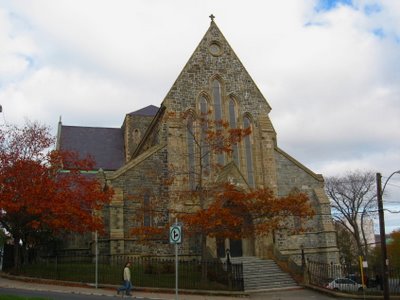 This is the Anglican church on Church Hill (I tried to remember the name, but I forgot).
 Gower Street United Church - this is taken from almost the same spot as the previous (Ang.) photo.
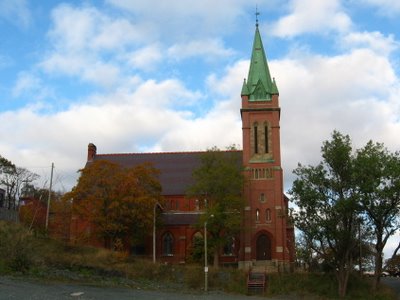 St. Andrew's Presbyterian (The Kirk) - A little ways up the slope; we're not on Church Hill anymore.
 Basilica of St. John the Baptist (RC) - The oldest RC parish in North America
All photos by Murray Speer (c) 2006

One thing about St. John's is they have some incredibly beautiful churches. I took some photos of some of the most beautiful downtown churches, representing four of the mainline denominations (I don't think I've seen a Lutheran church since I got to Newfoundland... probably longer than that.) I didn't worship in any of these churches; I went to George Street United when I was there, and I didn't get a photo of that one (alas). Enjoy!
 This is the Anglican church on Church Hill (I tried to remember the name, but I forgot).
 Gower Street United Church - this is taken from almost the same spot as the previous (Ang.) photo.
 St. Andrew's Presbyterian (The Kirk) - A little ways up the slope; we're not on Church Hill anymore.
 Basilica of St. John the Baptist (RC) - The oldest RC parish in North America
All photos by Murray Speer (c) 2006
Sunday, November 12, 2006
First United Church

This is a picture of the church that I'm working at until April. This is the church's website.
I've stopped putting my sermons up on the blog because it seems I've stopped (for the most part) writing manuscripts ahead of time.
I'm considering getting a digital recorder so that I can podcast my sermons, but that hasn't happened yet. We'll see.
Anyway, blessings to all.
Murray
Wednesday, November 08, 2006
Wondercafe...
I have to add my endorsement to the apparent flood of bloggers supporting the new website Wondercafe.ca.
I don't have much else to say about it... Set aside some time and check it out. I think I'll probably be getting more involved with it as time goes by (even though I'm not in their target demographic).
Yay Wondercafe! Yay E-Z Answer Squirrel! Yay United Church!

(Though I am disappointed that they don't pronounce it "Ee-zed Answer Squirrel" - we've become so Americanized with their Ee-zee this and Ee-zee that.)
I don't have much else to say about it... Set aside some time and check it out. I think I'll probably be getting more involved with it as time goes by (even though I'm not in their target demographic).
Yay Wondercafe! Yay E-Z Answer Squirrel! Yay United Church!
(Though I am disappointed that they don't pronounce it "Ee-zed Answer Squirrel" - we've become so Americanized with their Ee-zee this and Ee-zee that.)
Saturday, November 04, 2006
Some Photos From My Recent Trip
Last week, my dad came to Corner Brook for 10 days, and during that time we did some touring around the island, including a multi-day trip to St. John's. I'm posting a few select photos of that trip. They were chosen to accompany the "Reflections on Water" piece from a couple of days ago, but I'm only managing to put them up now. So they get their own post! I'm quite pleased with the photography on these. I took the three that don't have me in them, and my dad took the other one.

This is a shot of the landscape around the Bay of Islands,
which is the body of water that Corner Brook sits on.
This is on the way out to the mouth of the bay,
which empties into the Gulf of St. Lawrence.
This is me at Cape Spear, the easternmost point in
North America. I hadn't seen the Atlantic Ocean in
over 16 years. It looked the same.

This is Rocky Harbour, which is on the Gulf of St. Lawrence
and in Gros Morne National Park. There's a cute little lighthouse right
behind me as I snap this. We hit Gros Morne on a cold, rainy day.

This is a shot of St. John's Harbour from inside "The Rooms",
which is the provincial museum, art gallery, and archives
for Newfoundland and Labrador. Signal Hill is on the left,
where Marconi received the first transatlantic wireless signal.
Off to the right is Cape Spear. The figure in the foreground is my father.

This is a shot of the landscape around the Bay of Islands,
which is the body of water that Corner Brook sits on.
This is on the way out to the mouth of the bay,
which empties into the Gulf of St. Lawrence.

This is me at Cape Spear, the easternmost point in
North America. I hadn't seen the Atlantic Ocean in
over 16 years. It looked the same.

This is Rocky Harbour, which is on the Gulf of St. Lawrence
and in Gros Morne National Park. There's a cute little lighthouse right
behind me as I snap this. We hit Gros Morne on a cold, rainy day.

This is a shot of St. John's Harbour from inside "The Rooms",
which is the provincial museum, art gallery, and archives
for Newfoundland and Labrador. Signal Hill is on the left,
where Marconi received the first transatlantic wireless signal.
Off to the right is Cape Spear. The figure in the foreground is my father.
Thursday, November 02, 2006
Leader Test

Hmm... I followed the link from Carmen's blog and took the test. I like the humourous explanations. Hers was JFK and said, "You like power because it increases your sexual options." Apparently, I will either save the world or destroy it.
I already knew that Einstein and I have the same Enneagram type, which made me wonder about this test. I checked out the list of possible results, and it turns out that the "Leader Test" is in fact an Enneagram test. They are arranged in numerical order, and I like that because it puts my type (Five) right smack in the middle. Check it out; if you know your Enneagram Type, you don't have to go through the test. Although you might want to take the test and lie if you're a Six or an Eight and don't want to be told that you're Hitler or Saddam.

Wednesday, November 01, 2006
Reflections on Water
Kerry Child, the Associate Minister at Gilmore Park United Church in Richmond, BC, recently asked people to send her their thoughts and memories about water, from a Canadian perspective, to be used at the upcoming BC Junior Youth Conference of the United Church of Canada. What follows is the two-page reflection that I sent her, with the invitation to use it or excerpt it as she saw fit. I'll post it here in its entirety.
Reflections on Water
From the personal experience of Murray Speer
I grew up in a farming family on the Prairies. In Edmonton, water arrives in three forms: rain, snow, and the river. In the Spring, rain washes the land clean and brings the smell of ozone. Spring rain on the prairie for me is a symbol of freshness and opportunity. However, in the Summer months, rain comes in the form of thunder storms. When cumulonimbus clouds tower over the rolling prairie, I am reminded of the immense size and incredibly beauty of God’s world. And when the towering clouds turn dark, they become images of the power and danger that are present in nature. A single hail shower can destroy an entire Summer worth of growth in the grain fields, and a tornado can destroy even more than that.
In Winter comes the snow, which for me has become a symbol of waiting. As the Earth points its northern pole away from the warmth and life of the Sun, we withdraw into our caves of steel and stone and wood, emerging for few reasons. One of these reasons is to play in the snow, in the wonderful miracle of water in solid form, covering everything as far as the eye can see. As feet trudge through it, bodies roll in it, and tongues taste it, we delight in a wonderful paradox. The world seems dead, yet we live a third of the year – a third of our lives – in this time of deadness. For us, snow is not something that happens to water; it is not something that water does. For us, this is water in its natural state. But still, we wait, for the return of the sun, and the cleansing Spring rain.
And there is the river. I have often thought that if I had grown up near the banks of the North Saskatchewan River with no knowledge of the rest of the world – if I had never seen the vast fields of ice and snow in the Rocky Mountains, or seen the vast oceans themselves – then I might have believed that the river had no beginning and no end. It is just water itself: broad and deep and slow for half the year, white and smooth for the other half, but always permanent. The deep channel that the river follows through Edmonton, which is home to wildlife and nature lovers, downhill skiers, and the longest continuous expanse of urban parkland in North America, was carved by the runoff of the glaciers at the end of the last ice age: an amount of water virtually unimaginable to a prairie-born farmboy.
When I was young, my family often vacationed in the mountains of British Columbia. In the months of May, June, and July, water seems to endlessly cavort down the sides of these tree-clad hills, in trickles, rivulets, streams, and occasionally outright cascades. I remember riding in the backseat of the family station wagon as my father negotiated the winding mountain roads, and every waterfall he saw (every one!) would be met with an exclamation: “there’s a waterfall,” or, “look at the water coming down that hill.” It became such a refrain with him that my sister and I began on one particular trip to tease him about it, saying, “Whoop-de-doo!” every time he would point out yet another waterfall; which to us, of course, looked just like every waterfall he had pointed out that morning, and for the last two days. It took me much longer to realize how those waterfalls appeared to him, a prairie-born grain farmer, whose livelihood depended on water falling from the sky at precisely the right time. From that perspective, every single waterfall on the side of every single mountain along that highway becomes a little miracle. Whoop-de-doo, indeed.
I recently had the opportunity to drive across Canada for the first time. Even after having lived in Vancouver for two years, on the shores of the Strait of Georgia, I’m still impressed by large amounts of water. For me, if I have to move my head to see all of it, then it’s an incredible amount of water. So I hope you can imagine how powerful an experience it was for me to drive along the Trans-Canada Highway along the shore of Lake Superior. I went halfway around the lake, and it took me eight hours of driving. For long stretches, the water would be out of view as the highway curved behind stony peaks and patches of woodland. Then, a harbour or bay would emerge into view, in an absolutely stunning shade of blue-green, and a second or two would pass as I admired the view before I realized: this is still the same lake that I have been driving around all day!
I have seen the icefields of the Rocky Mountains, which feed the prairie rivers. I have seen the Pacific Ocean from both sides, and just last week I visited both the Atlantic Ocean and the Gulf of St. Lawrence. I have seen the Great Lakes and the Gulf of Mexico. Some of the happiest memories of my early life include swimming in lakes and oceans around Canada and the world. And it is only now that I realize how my stories of water are stories of blessing and abundance. Other people’s water stories will include drought and pollution, pain and concern.
The call that I am hearing, out of this time of thinking about water, is toward a greater attitude of sharing. Just as there is one Earth, there is also one Water. But I don’t mean sharing our water – as though Canada’s water could be sent elsewhere and thus solve all our problems – I mean sharing our stories, so that my stories of blessing and abundance can become real for people who do not have similar experiences, and the stories that other people have of drought and pollution can become real for me.
So that whether we are in the Georgia Strait or the Bay of Islands, the North or the South, the snow or the drought, we have all of it in mind, so that we are truly living with respect in Creation, loving and serving others, seeking justice, resisting evil, and being faithful stewards of our resources, and so that water can continue to mean all that it has meant, in all of its wonderful variety and miraculous power.
Reflections on Water
From the personal experience of Murray Speer
I grew up in a farming family on the Prairies. In Edmonton, water arrives in three forms: rain, snow, and the river. In the Spring, rain washes the land clean and brings the smell of ozone. Spring rain on the prairie for me is a symbol of freshness and opportunity. However, in the Summer months, rain comes in the form of thunder storms. When cumulonimbus clouds tower over the rolling prairie, I am reminded of the immense size and incredibly beauty of God’s world. And when the towering clouds turn dark, they become images of the power and danger that are present in nature. A single hail shower can destroy an entire Summer worth of growth in the grain fields, and a tornado can destroy even more than that.
In Winter comes the snow, which for me has become a symbol of waiting. As the Earth points its northern pole away from the warmth and life of the Sun, we withdraw into our caves of steel and stone and wood, emerging for few reasons. One of these reasons is to play in the snow, in the wonderful miracle of water in solid form, covering everything as far as the eye can see. As feet trudge through it, bodies roll in it, and tongues taste it, we delight in a wonderful paradox. The world seems dead, yet we live a third of the year – a third of our lives – in this time of deadness. For us, snow is not something that happens to water; it is not something that water does. For us, this is water in its natural state. But still, we wait, for the return of the sun, and the cleansing Spring rain.
And there is the river. I have often thought that if I had grown up near the banks of the North Saskatchewan River with no knowledge of the rest of the world – if I had never seen the vast fields of ice and snow in the Rocky Mountains, or seen the vast oceans themselves – then I might have believed that the river had no beginning and no end. It is just water itself: broad and deep and slow for half the year, white and smooth for the other half, but always permanent. The deep channel that the river follows through Edmonton, which is home to wildlife and nature lovers, downhill skiers, and the longest continuous expanse of urban parkland in North America, was carved by the runoff of the glaciers at the end of the last ice age: an amount of water virtually unimaginable to a prairie-born farmboy.
When I was young, my family often vacationed in the mountains of British Columbia. In the months of May, June, and July, water seems to endlessly cavort down the sides of these tree-clad hills, in trickles, rivulets, streams, and occasionally outright cascades. I remember riding in the backseat of the family station wagon as my father negotiated the winding mountain roads, and every waterfall he saw (every one!) would be met with an exclamation: “there’s a waterfall,” or, “look at the water coming down that hill.” It became such a refrain with him that my sister and I began on one particular trip to tease him about it, saying, “Whoop-de-doo!” every time he would point out yet another waterfall; which to us, of course, looked just like every waterfall he had pointed out that morning, and for the last two days. It took me much longer to realize how those waterfalls appeared to him, a prairie-born grain farmer, whose livelihood depended on water falling from the sky at precisely the right time. From that perspective, every single waterfall on the side of every single mountain along that highway becomes a little miracle. Whoop-de-doo, indeed.
I recently had the opportunity to drive across Canada for the first time. Even after having lived in Vancouver for two years, on the shores of the Strait of Georgia, I’m still impressed by large amounts of water. For me, if I have to move my head to see all of it, then it’s an incredible amount of water. So I hope you can imagine how powerful an experience it was for me to drive along the Trans-Canada Highway along the shore of Lake Superior. I went halfway around the lake, and it took me eight hours of driving. For long stretches, the water would be out of view as the highway curved behind stony peaks and patches of woodland. Then, a harbour or bay would emerge into view, in an absolutely stunning shade of blue-green, and a second or two would pass as I admired the view before I realized: this is still the same lake that I have been driving around all day!
I have seen the icefields of the Rocky Mountains, which feed the prairie rivers. I have seen the Pacific Ocean from both sides, and just last week I visited both the Atlantic Ocean and the Gulf of St. Lawrence. I have seen the Great Lakes and the Gulf of Mexico. Some of the happiest memories of my early life include swimming in lakes and oceans around Canada and the world. And it is only now that I realize how my stories of water are stories of blessing and abundance. Other people’s water stories will include drought and pollution, pain and concern.
The call that I am hearing, out of this time of thinking about water, is toward a greater attitude of sharing. Just as there is one Earth, there is also one Water. But I don’t mean sharing our water – as though Canada’s water could be sent elsewhere and thus solve all our problems – I mean sharing our stories, so that my stories of blessing and abundance can become real for people who do not have similar experiences, and the stories that other people have of drought and pollution can become real for me.
So that whether we are in the Georgia Strait or the Bay of Islands, the North or the South, the snow or the drought, we have all of it in mind, so that we are truly living with respect in Creation, loving and serving others, seeking justice, resisting evil, and being faithful stewards of our resources, and so that water can continue to mean all that it has meant, in all of its wonderful variety and miraculous power.
Wednesday, October 11, 2006
The Connection Between Love And Death: A Rant
So here's something that's been rattling around in my head for several months now. When I take a close, diagnostic look at the culture around me, I see a certain preoccupation with love and death.
The problem is, I think in general we have a flawed perspective on both.
My general experience is that when someone mentions 'love', the images that come to mind (for me and for others) are images of romance and eroticism, and these primarily in the context of one-to-one relationships (ie. intimacy).
So when putative 'love' songs are played (some examples: U2's "When Love Comes To Town", Evanescence's "Bring Me To Life", Enrique Iglesias' "Hero") the imagination jumps to romantic and erotic conclusions.
However, there is nothing in any of these songs (and many others) to indicate that they are actually about romance or eroticism (leaving aside the issue of music videos, which often introduce themes that are not obviously present in the songs - this is the case with "Hero"). They may, in fact, be about Love.
Scott Peck defines Love as "the willingness to extend oneself for the sake of one's own or another's spiritual growth" (paraphrased, The Road Less Taken).
And the apostle Paul wrote the following:
On the other hand, we avoid death, treating it like an enemy. What if Love and Death are more connected than many of us like to imagine?
The experience that got me thinking about this question was seeing the promotional wrapping for the DVD collection of Buffy the Vampire Slayer Season 5. You see, in one particular episode of that season (the episode "Intervention"), Buffy, the superpowered guardian of her world, takes a vision quest in an attempt to better understand her power, her calling, and her duty.
The message she receives from her spirit guide is troubling to her. For almost five years, she has been immersed in death. She fights undead vampires, she kills demons and sorcerers, she has herself been drowned and revived, and shortly before the episode in question, her mother died of complications due to brain surgery.
The message is two-fold:
"Love will lead you to your Gift."
"Death is your Gift."
Buffy's response is resolute: "Death," she says, "is not a gift."
But this message throws her into self-doubt. She has spent a lot of energy convincing herself that a Slayer is something more than just a killer; that she has a calling above and beyond the blood-and-guts of nightly patrols and demon fighting. How can death be her gift?
What she neglects is the first portion of the message: "Love will lead you to your Gift."
How can a Love, which leads to a Death, be a Gift? In a Christian context, this concept is not difficult to understand. And Buffy understands as well, when the time comes. In the final episode of the season (the episode is called "The Gift") she sacrifices herself in an act of love, saving the world from an onslaught of evil and destructive forces.
So that's all well and good. Kudos to Joss Whedon for portraying a character who does not see a link between Love and Death, but discovers it when the time is right.
But that promotional packaging... do you know what it said? It said, "Buffy learns that love is the greatest gift of all."
Love is the Gift? What? At first glance, it seems to be connected to the chapter from 1 Corinthians that I quoted above. The NRSV, of course, calls this chapter "The Gift of Love." Love is the greatest spiritual gift, says Paul. Love is the greatest gift, says the packaging from the Buffy Season 5 DVD set. But the Love that Paul writes of is intimately connected with death. And the love that Buffy discovers in her journey is intimately connected with death, also.
When you just throw that statement out there - Love is the greatest gift of all - without any explanation, you have to assume that people are going to be thinking of mushy, sentimental love. Paul writes an entire chapter explaining what he means when he says "love." Scott Peck wrote an entire book. It took Buffy five episodes to figure it out.
When love is framed as a romantic, erotic, or sentimental condition, it is easy to convince ourselves that we are satisfying the Great Commandment, to love God, neighbour, and self. It's easy to have mushy feelings about everyone, and if that is the greatest gift, then we're all doing okay. But love isn't the greatest gift. Love, if you remember, will lead you to your gift.
So what is it? Death? For Buffy, at that point in her life, it was. But I don't think that's true for everyone. Love will lead you to your Gift, whatever it might be. And your Gift is not something that you will receive... it is something that you already have, and that you are being called to give away. What will it be? Love will show you the way.
But not a romantic or erotic love. This is another kind of Love.
Why would they write that on the promotional packaging? Love is the greatest gift of all. A charitable view would be that they didn't want to reveal the secret, so they said something ambiguous and (somewhat) intriguing. A cynical view would be that they thought their audience would not understand or be 'turned-off' if they wrote what really happened. A pessimistic view would be that they are so wrapped up in the fluffy bubblegum culture that they actually can't see the difference between what they wrote and what happened.
Which of these is accurate? There's no way to know. But I am convinced that it reveals a deeper problem in our culture, namely our unhealthy concepts of love and death as simple, unconnected, and easy. Because when I hear the songs that I named above, I hear something very different. I hear them talking about a love that is hard. A love that takes us deep. A love that calls us to our greatest gift.
And when people say something like, "Jesus was all about love," how are we to take that? Was he all about being nice? A careful reading of the stories about him would say no, he was not primarily interested in being nice to people. No, if he was all about love, then it was a different kind of love than is most commonly discussed in our culture.
But he also wasn't primarily interested in dying, which seems to be the focus of a lot of Christians these days. That he was "here to go," in the sense that his purpose and calling in life were to die.
No, the meaning only comes when the two are connected. For Buffy, and for Jesus, the significance of their deaths is that they are acts of love... not romantic love; not mushy sentimental love; but the spiritual gift of love described by Paul.
Without their willingness to extend themselves even to the point of death for the sake of others growth and 'salvation', their Love would be empty or incomplete. And without the Love that showed them the way, their deaths would be meaningless.
That is the meaning of the cross.
 Image credit: www.screencap-paradise.com
The problem is, I think in general we have a flawed perspective on both.
My general experience is that when someone mentions 'love', the images that come to mind (for me and for others) are images of romance and eroticism, and these primarily in the context of one-to-one relationships (ie. intimacy).
So when putative 'love' songs are played (some examples: U2's "When Love Comes To Town", Evanescence's "Bring Me To Life", Enrique Iglesias' "Hero") the imagination jumps to romantic and erotic conclusions.
However, there is nothing in any of these songs (and many others) to indicate that they are actually about romance or eroticism (leaving aside the issue of music videos, which often introduce themes that are not obviously present in the songs - this is the case with "Hero"). They may, in fact, be about Love.
Scott Peck defines Love as "the willingness to extend oneself for the sake of one's own or another's spiritual growth" (paraphrased, The Road Less Taken).
And the apostle Paul wrote the following:
This chapter is often read at weddings, which is fine, but again, it shifts Paul's love discourse into the context of romantic and erotic love, instead of Love.The Gift of Love
If I speak in the tongues of mortals and of angels, but do not have love, I am a noisy gong or a clanging cymbal. And if I have prophetic powers, and understand all mysteries and all knowledge, and if I have all faith, so as to remove mountains, but do not have love, I am nothing. If I give away all my possessions, and if I hand over my body so that I may boast, but do not have love, I gain nothing.
Love is patient; love is kind; love is not envious or boastful or arrogant or rude. It does not insist on its own way; it is not irritable or resentful; it does not rejoice in wrongdoing, but rejoices in the truth. It bears all things, believes all things, hopes all things, endures all things.
Love never ends. But as for prophecies, they will come to an end; as for tongues, they will cease; as for knowledge, it will come to an end. For we know only in part, and we prophesy only in part; but when the complete comes, the partial will come to an end. When I was a child, I spoke like a child, I thought like a child, I reasoned like a child; when I became an adult, I put an end to childish ways. For now we see in a mirror, dimly, but then we will see face to face. Now I know only in part; then I will know fully, even as I have been fully known. And now faith, hope, and love abide, these three; and the greatest of these is love.
On the other hand, we avoid death, treating it like an enemy. What if Love and Death are more connected than many of us like to imagine?
The experience that got me thinking about this question was seeing the promotional wrapping for the DVD collection of Buffy the Vampire Slayer Season 5. You see, in one particular episode of that season (the episode "Intervention"), Buffy, the superpowered guardian of her world, takes a vision quest in an attempt to better understand her power, her calling, and her duty.
The message she receives from her spirit guide is troubling to her. For almost five years, she has been immersed in death. She fights undead vampires, she kills demons and sorcerers, she has herself been drowned and revived, and shortly before the episode in question, her mother died of complications due to brain surgery.
The message is two-fold:
"Love will lead you to your Gift."
"Death is your Gift."
Buffy's response is resolute: "Death," she says, "is not a gift."
But this message throws her into self-doubt. She has spent a lot of energy convincing herself that a Slayer is something more than just a killer; that she has a calling above and beyond the blood-and-guts of nightly patrols and demon fighting. How can death be her gift?
What she neglects is the first portion of the message: "Love will lead you to your Gift."
How can a Love, which leads to a Death, be a Gift? In a Christian context, this concept is not difficult to understand. And Buffy understands as well, when the time comes. In the final episode of the season (the episode is called "The Gift") she sacrifices herself in an act of love, saving the world from an onslaught of evil and destructive forces.
So that's all well and good. Kudos to Joss Whedon for portraying a character who does not see a link between Love and Death, but discovers it when the time is right.
But that promotional packaging... do you know what it said? It said, "Buffy learns that love is the greatest gift of all."
Love is the Gift? What? At first glance, it seems to be connected to the chapter from 1 Corinthians that I quoted above. The NRSV, of course, calls this chapter "The Gift of Love." Love is the greatest spiritual gift, says Paul. Love is the greatest gift, says the packaging from the Buffy Season 5 DVD set. But the Love that Paul writes of is intimately connected with death. And the love that Buffy discovers in her journey is intimately connected with death, also.
When you just throw that statement out there - Love is the greatest gift of all - without any explanation, you have to assume that people are going to be thinking of mushy, sentimental love. Paul writes an entire chapter explaining what he means when he says "love." Scott Peck wrote an entire book. It took Buffy five episodes to figure it out.
When love is framed as a romantic, erotic, or sentimental condition, it is easy to convince ourselves that we are satisfying the Great Commandment, to love God, neighbour, and self. It's easy to have mushy feelings about everyone, and if that is the greatest gift, then we're all doing okay. But love isn't the greatest gift. Love, if you remember, will lead you to your gift.
So what is it? Death? For Buffy, at that point in her life, it was. But I don't think that's true for everyone. Love will lead you to your Gift, whatever it might be. And your Gift is not something that you will receive... it is something that you already have, and that you are being called to give away. What will it be? Love will show you the way.
But not a romantic or erotic love. This is another kind of Love.
Why would they write that on the promotional packaging? Love is the greatest gift of all. A charitable view would be that they didn't want to reveal the secret, so they said something ambiguous and (somewhat) intriguing. A cynical view would be that they thought their audience would not understand or be 'turned-off' if they wrote what really happened. A pessimistic view would be that they are so wrapped up in the fluffy bubblegum culture that they actually can't see the difference between what they wrote and what happened.
Which of these is accurate? There's no way to know. But I am convinced that it reveals a deeper problem in our culture, namely our unhealthy concepts of love and death as simple, unconnected, and easy. Because when I hear the songs that I named above, I hear something very different. I hear them talking about a love that is hard. A love that takes us deep. A love that calls us to our greatest gift.
And when people say something like, "Jesus was all about love," how are we to take that? Was he all about being nice? A careful reading of the stories about him would say no, he was not primarily interested in being nice to people. No, if he was all about love, then it was a different kind of love than is most commonly discussed in our culture.
But he also wasn't primarily interested in dying, which seems to be the focus of a lot of Christians these days. That he was "here to go," in the sense that his purpose and calling in life were to die.
No, the meaning only comes when the two are connected. For Buffy, and for Jesus, the significance of their deaths is that they are acts of love... not romantic love; not mushy sentimental love; but the spiritual gift of love described by Paul.
Without their willingness to extend themselves even to the point of death for the sake of others growth and 'salvation', their Love would be empty or incomplete. And without the Love that showed them the way, their deaths would be meaningless.
That is the meaning of the cross.
 Image credit: www.screencap-paradise.com
Sunday, September 24, 2006
Photo From Orientation

Last week I attended Internship Orientation in Grand Falls-Windsor, Newfoundland. It was a wonderful experience, and I thought I would share this photo from that event. From left to right, we have the Conference Personnel Minister, Rev. Faith March-MacCuish, myself, and three members of my Lay Supervision Team, Judy Spracklin, Donna Hollett, and Keith Mercer. Not pictured are my supervisor, Rev. Wayne Cole, and the fourth member of my team, Roy Warren, who were unable to make it to the event.
There is one other Intern Minister in Newfoundland & Labrador Conference right now, and she was also present, with her supervisor and one member of her lay team (her supervisor took the photo; that is her finger in the top corner.) The other Intern's name is Wendy, and she is from Ontario, studying in Montreal, and doing her Internship in St. John's.
We had a lovely two days together. I drove down to Grand Falls with my team and we got to know each other in the car. The orientation was held at a former convent, that is now a retreat center operated by the sisters. Apparently, NL Conference does most of its orientations and retreats there, because of its central location on the TCH between Port-aux-Basques and St. John's. The accommodations were wonderful and the sisters were very friendly and supportive. Plus, there was a laundry chute that kept Judy very amused.
I think often of all the folks in my first four homes of Fort Saskatchewan, Edmonton, Vancouver, and Richmond who I have left behind for this fifth home, and I enjoy hearing from everyone via e-mail, IM, and phone.
Love and blessings,
Murray
Friday, September 15, 2006
Sermon from September 10, 2006
Wow! It's been a month and a half and so much has happened. It's taken some time to process everything, and now that I've gained some perspective I should be able to start telling stories again for you folk... but we'll start with something I've already written.
July 30 was my last Sunday at Gilmore Park United Church, and on September 10 I started at First United Church in Corner Brook, Newfoundland, almost 7000 km away! (Well, I don't kn0w how far it is as the crow flies; that's the distance as the Dodge Caravan drives, though!)
Here is the manuscript of the sermon I delivered last Sunday at First United, on what we called "Rally Day" - the first day back from summer and the start of the church programs for the year.
Once again, I am making this caveat: the manuscript is not the sermon. It is the visual cue that gives the sermon its structure and flow; the sermon is what is spoken and heard, not what is written. I invite your comments and feedback!
July 30 was my last Sunday at Gilmore Park United Church, and on September 10 I started at First United Church in Corner Brook, Newfoundland, almost 7000 km away! (Well, I don't kn0w how far it is as the crow flies; that's the distance as the Dodge Caravan drives, though!)
Here is the manuscript of the sermon I delivered last Sunday at First United, on what we called "Rally Day" - the first day back from summer and the start of the church programs for the year.
Once again, I am making this caveat: the manuscript is not the sermon. It is the visual cue that gives the sermon its structure and flow; the sermon is what is spoken and heard, not what is written. I invite your comments and feedback!
September 10, 2006
Sermon
Murray Speer
Mark 12:28-34
One of the scribes came near and heard them disputing with one another, and seeing that he answered them well, he asked him, ‘Which commandment is the first of all?’ Jesus answered, ‘The first is, “Hear, O Israel: the Lord our God, the Lord is one; you shall love the Lord your God with all your heart, and with all your soul, and with all your mind, and with all your strength.” The second is this, “You shall love your neighbour as yourself.” There is no other commandment greater than these.’ Then the scribe said to him, ‘You are right, Teacher; you have truly said that “he is one, and besides him there is no other”; and “to love him with all the heart, and with all the understanding, and with all the strength”, and “to love one’s neighbour as oneself”,—this is much more important than all whole burnt-offerings and sacrifices.’ When Jesus saw that he answered wisely, he said to him, ‘You are not far from the kingdom of God.’ After that no one dared to ask him any question.
So here we are. Here I am. Reverend Cole suggested that I should take this opportunity to tell you something about myself, here on Rally Day and on my first Sunday morning in leadership here. So here I am.
I’m not really accustomed to talking about myself. I usually think that folks will learn about me what they need to know, and I am more than willing to share personal details when the situation calls for it, or when someone asks… but to stand up and intentionally talk about myself is not something I’m used to doing. For one thing, when I’m preaching the gospel, it’s really not about me. I am called by God and given certain gifts to do this task… but it’s not about me.
So preparing to talk about myself has been more difficult than I imagined it would be when I agreed to it. On the one hand, mine is just the same old story, of a young man traveling from Alberta to Newfoundland… for work. I grew up near Edmonton, Alberta where my family grows canola, wheat, and peas. Edmonton is the northernmost metropolis in the western hemisphere, and when you live there, you know it. The winter lasts six months, and the schools don’t close until the temperature reaches -50. But in the summer, at midnight on midsummer day, the horizon due north glows with the light of a sun which you almost believe is hiding just out of sight, waiting to burst forth only a few hours later.
I worked on the farm when I was a teenager, but I was never really a farmer. After high school I moved into Edmonton to attend University. I worked in various jobs during my degree… I worked at a living history site called Fort Edmonton Park, where I wore period costume and operating the penny arcade, shooting gallery, and miniature golf course. In the summer of 2001, when the UK and Europe suffered major outbreaks of Foot and Mouth Disease in their livestock, I worked for the federal government at the Edmonton Airport in Plant and Animal Health, interviewing arriving travelers and protecting Canada’s plants and animals. I was a blackjack dealer at a local casino, and I did telephone interviews for a market research company. But with all of these jobs, I knew that I was biding my time, getting ready for what I was supposed to be doing, which was this. Preaching, leading worship, and caring for people.
In the meantime, I was involved at my local church, First United in Fort Saskatchewan, Alberta. My mother had been a member there when she was young, and I started attending there when I was 19, eventually becoming both the Chair of the Congregation and the Chair of the Church Council, and being confirmed as a member when I was 21. I did my discernment for ministry there, and I am a candidate for ordination in Yellowhead Presbytery in Alberta.
Two years ago, I left Edmonton and started my Master of Divinity degree at the Vancouver School of Theology. VST is a multi-denominational school, with three different sponsoring churches and several others who recognize its programs, so I have studied alongside students from the United, Anglican, Presbyterian, Catholic, Lutheran, Unitarian, Reformed, and Baptist streams. It also has the only Divinity program in North America that is specifically tailored for First Nations students and communities.
I did my first and second-year field placement work at a congregation called Gilmore Park United in Richmond, British Columbia. Gilmore Park is one of many churches in BC and Alberta (and across the country) that are working very hard to answer the questions of what it means to be church in today’s world, and what that will look like. As a group, they have experienced the ending of an old paradigm and committed themselves to faithfully embodying Christian principles in whatever new paradigm is emerging. It was a very special experience for me to work with them in this endeavour, and I hope the things I saw and did there have something to offer to us here at First United.
So these are the places I have been, and now I have driven across the country and arrived here. At each step along the way, I have tried to trust the call of God, show up where I am needed, and do my best with what I had, and I am committed to continuing to show up and do my best with all of you folk. I know that I will make mistakes, and I know that there will be many of you who are also trusting the call of God, showing up where you are needed, and doing your best with what you have. Together, maybe we can get some things done.
This morning, I was up putting the finishing touches on my words for you all, and on CBC radio they played an old Beatles song… “Love is all you need.” Do you know that one? It’s a favourite of mine… there are some words in that song that always give me the shivers. Have you ever paid attention to the words in that song?
“There’s nothing you can do that can’t be done… Nothing you can sing that can’t be sung… Nothing you can make that can’t be made… No one you can saved that can’t be saved…”
“Nothing you can do but you can learn how to be you in time. It’s easy.”
Well, learning how to be me has not been easy. I’m not asking for sympathy or pity or even attention… after all, when I’m up here in front of you, it’s not about me. But so often, life has seemed so difficult. And IS, so difficult. But here we have John telling us… sorry, not the gospel of John; John Lennon… telling us that it’s easy. Has it really been easy for any of us?
Well, I can tell you this. It’s a lot easier when you do it in a community of faithful and caring people. And I don’t think John means that it’s “easy” in the sense that it doesn’t take work, because it does. And I don’t think he means “easy” in the sense that it doesn’t hurt, because it does.
I think he means it’s a simple process. Hard, yes. Painful, yes. But simple. Because every time he says, “it’s easy” he follows it with all the instructions you need: all you need is love.
And Jesus said, the greatest commandment is “Hear, O Israel, the Lord your God, the Lord is one. Love the Lord your God with all your heart and with all your soul and with all your mind and with all your strength. The second is this: love your neighbour as yourself. There is no greater commandment than these.”
Love. It’s difficult. It’s painful. It was difficult and painful for Christ; why should it not be for us? But it’s simple. It’s easy.
And it calls us to show up, trust the call of God, and do the best we can with what we have.
Here we are. Here I am.
“There’s nothing you can know that can’t be known… Nothing you can see that isn’t shown… There’s nowhere you can be that isn’t where you’re meant to be.”
It’s easy. All you need is love.
Subscribe to:
Posts (Atom)